
Downpipe Unblocking Birmingham | Fast Response
A gutter gets all the attention, but it is the downpipe that decides whether the whole system works. The gutter collects the water. The downpipe is the only way out. If that pipe is blocked, partly or fully, it does not matter how clean the gutter is: the water has nowhere to go, the gutter fills, and the overflow starts.
Downpipes are also the part of the system that people understand least. They run down the wall, out of sight behind brackets and planting, then disappear into a gully, a soakaway, a water butt or a drain. When one blocks, the sign is usually somewhere else entirely: a gutter overflowing at the corner, a stain behind a bracket, a puddle at the base, a gurgle in the wall during heavy rain.
This guide is about the pipe itself. It explains how downpipes are put together, where and why they block, how to find out where your blockage is, which unblocking methods work and which cause damage, who is responsible for the drain at the bottom, what is urgent and what is not, and what to ask before you hire. It is written to be used in any year, for homeowners, landlords and managing agents across Birmingham, Solihull, Sutton Coldfield, Wolverhampton, Walsall, Dudley and West Bromwich.
If you have a blocked downpipe now, we clear downpipes and check the flow from the ground, with no ladders, and we supply before and after photos with every job. You can call 0333 8804129 or request a free quote.
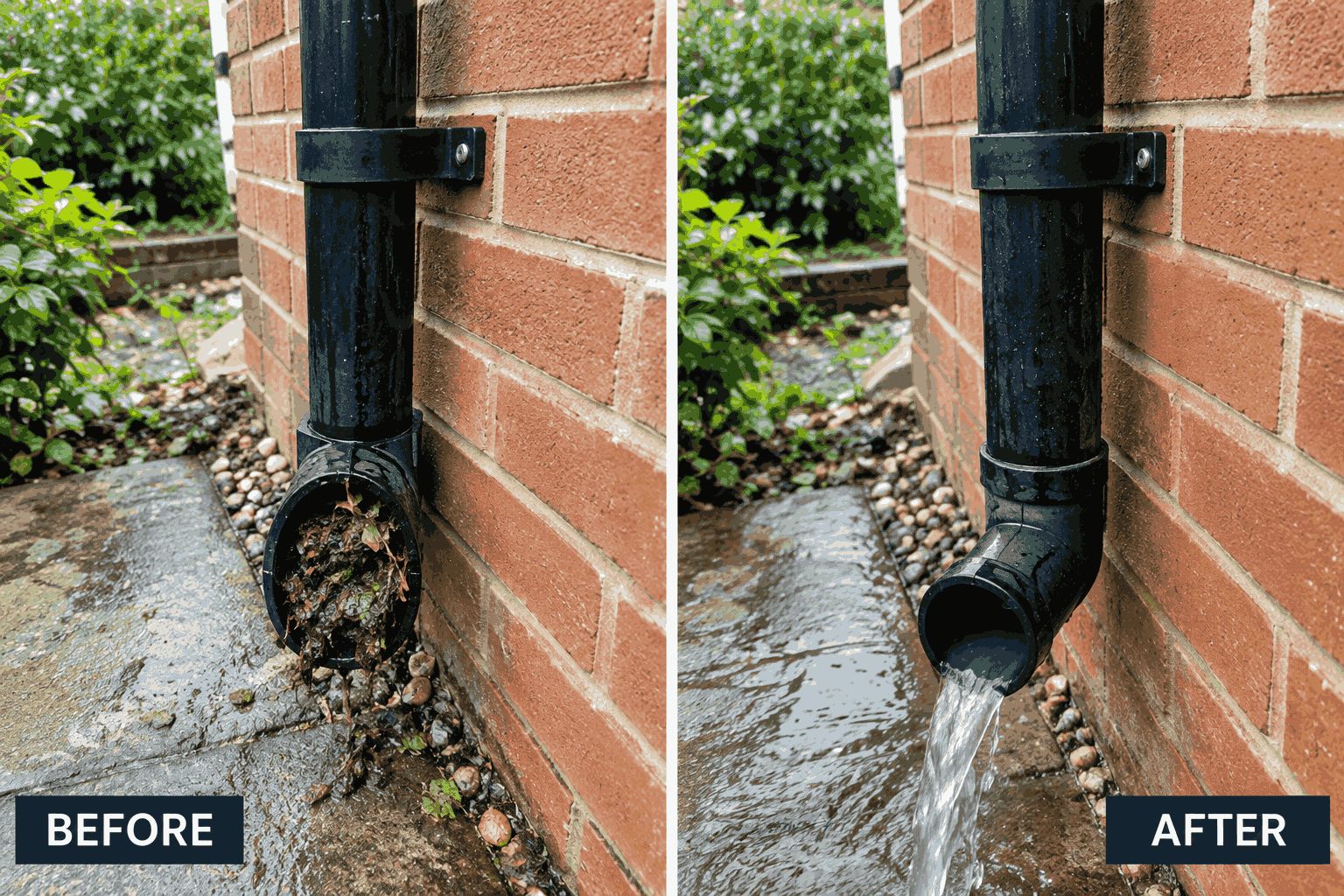
Unblocking vertical downpipes, clearing gutter outlets, inspecting swan necks and testing flow from ground level.
How This Guide Fits With Our Other Downpipe Articles
We have written about downpipes from a few angles, and it helps to know which does what:
Our guide to blocked downpipe signs Birmingham homes show is about recognising that a downpipe is blocked.
Our guide to the hidden damage behind blocked downpipes in Solihull covers what a blocked pipe does to walls, drains and foundations.
Our downpipe unblocking service page is where you go to book an engineer directly.
This guide is about the how: how the system works, how it blocks, how to locate the problem, and how it is properly cleared.
If you are not sure whether your pipe is blocked at all, start with the signs guide, and come back here for the next step.
The Anatomy of a Downpipe System
It is easier to understand a blockage once you know what the pipe is made of. A typical rainwater downpipe system has the following parts, from top to bottom:
| Part | What it is | Why it matters for blockages |
|---|---|---|
| Gutter outlet | The opening in the gutter where water drops into the pipe | The narrowest point; debris plugs form here first |
| Hopper head | A box at the top of some older downpipes that collects water from one or more gutters | Holds debris; can overflow if blocked |
| Pipe run | The straight vertical section | Usually clear unless debris has wedged or the pipe is damaged |
| Offsets and swan necks | Bends that carry the pipe around eaves or projections | Debris catches in the bends |
| Brackets | Fixings holding the pipe to the wall | Leaks and stains show here when the pipe backs up |
| Joints and sockets | Where sections connect | Weak points; leak when the pipe fills |
| Shoe | The angled section at the bottom that directs water away | Collects silt and leaves; often blocked |
| Gully or drain | The ground-level opening the pipe discharges into | Blocks with silt and leaves; backs water up the pipe |
| Underground drain, soakaway or butt | Where the water finally goes | Blockages here are not a downpipe problem, but look like one |
On a modern house the pipe is usually round or square plastic. On older properties, it may be cast iron, sometimes with a hopper head at the top, a decorative bracket every metre or so and a cast shoe at the bottom. Some buildings, especially commercial ones, have internal rainwater pipes hidden in walls or ducts, and some flat roofs drain through outlets straight into internal pipes.
Where Downpipes Block
Blockages are not random. They form in a handful of predictable places, and knowing which one you have changes how it is cleared.
1. At the top, in or just below the outlet
The commonest place. Leaves, silt, moss, seeds and roof granules wash along the gutter and pack into the outlet, forming a plug. Water backs up in the gutter above. This type is usually cleared from above, by suction or by hand.
2. In a bend or offset
A swan neck or offset bend is a natural catching point. Debris that passes the outlet can lodge in the bend and build up behind itself. These blockages can be deeper in the pipe and harder to see.
3. In the middle of the run
Less common, but it happens. A ball, a toy, a nest, a clump of compacted moss or a collapsed section of pipe can block the straight run. A bird nest in the top of a pipe is surprisingly common.
4. In the shoe
The shoe at the bottom collects whatever travels down the pipe. Silt settles in it. In winter, standing water in the shoe can freeze. A packed shoe makes the whole pipe above it drain slowly, and the symptom is often water pooling at the base or staining on the wall at the lowest bracket.
5. In the gully, drain or soakaway
The pipe may be clear, but the gully it empties into may be full of silt and leaves, so water backs up. This looks exactly like a blocked pipe from above. Further along, the drain itself may be blocked, collapsed or invaded by roots, or a soakaway may have silted up.
6. In a combined or shared drain
In some terraces, downpipes join a shared drain. A blockage in the shared section affects more than one property and may be the water company's responsibility rather than yours.
Our guide to roofline cleaning in Birmingham explains how the whole edge of the roof works together, and why the downpipe is the last link in that chain.
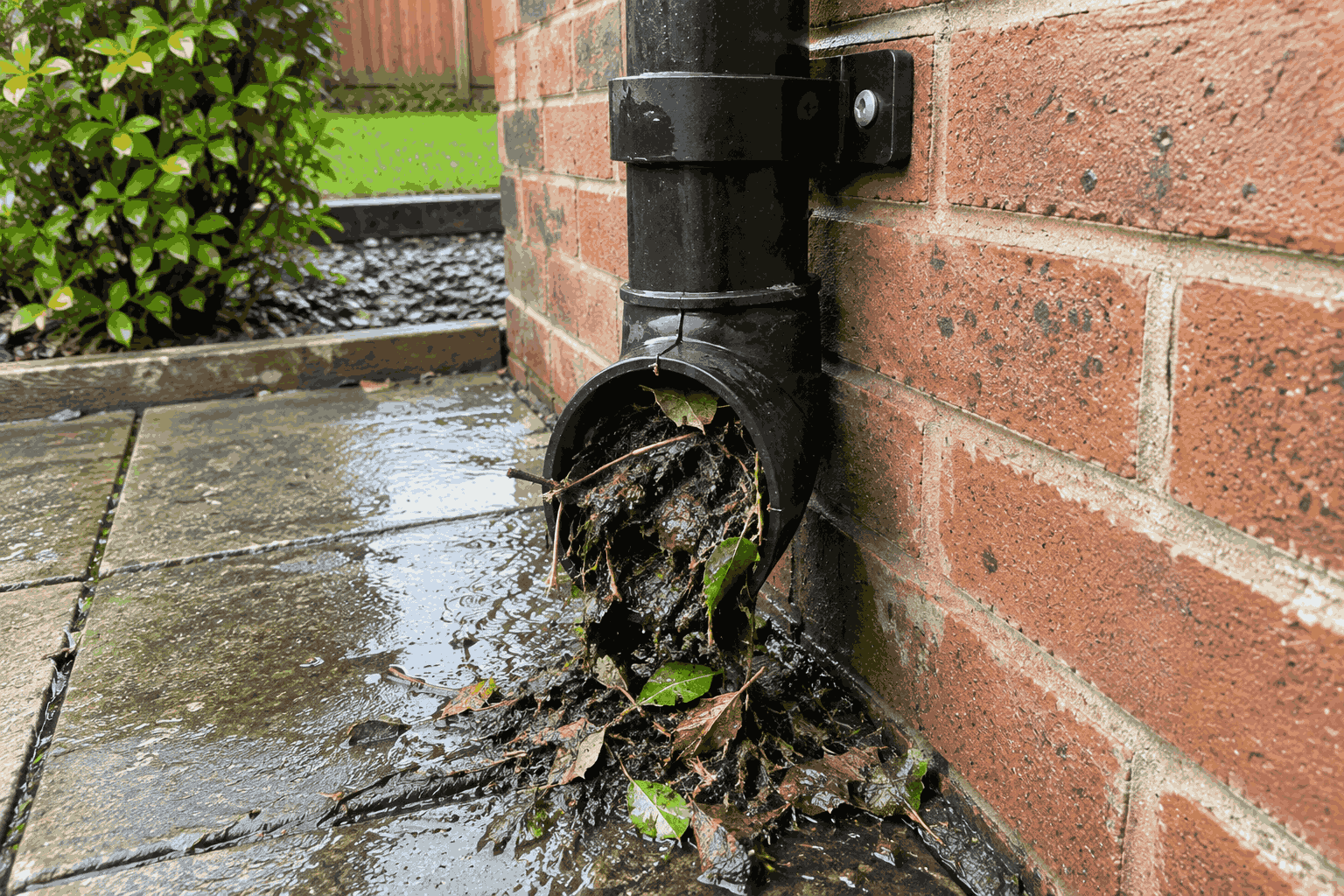 Before Clearing
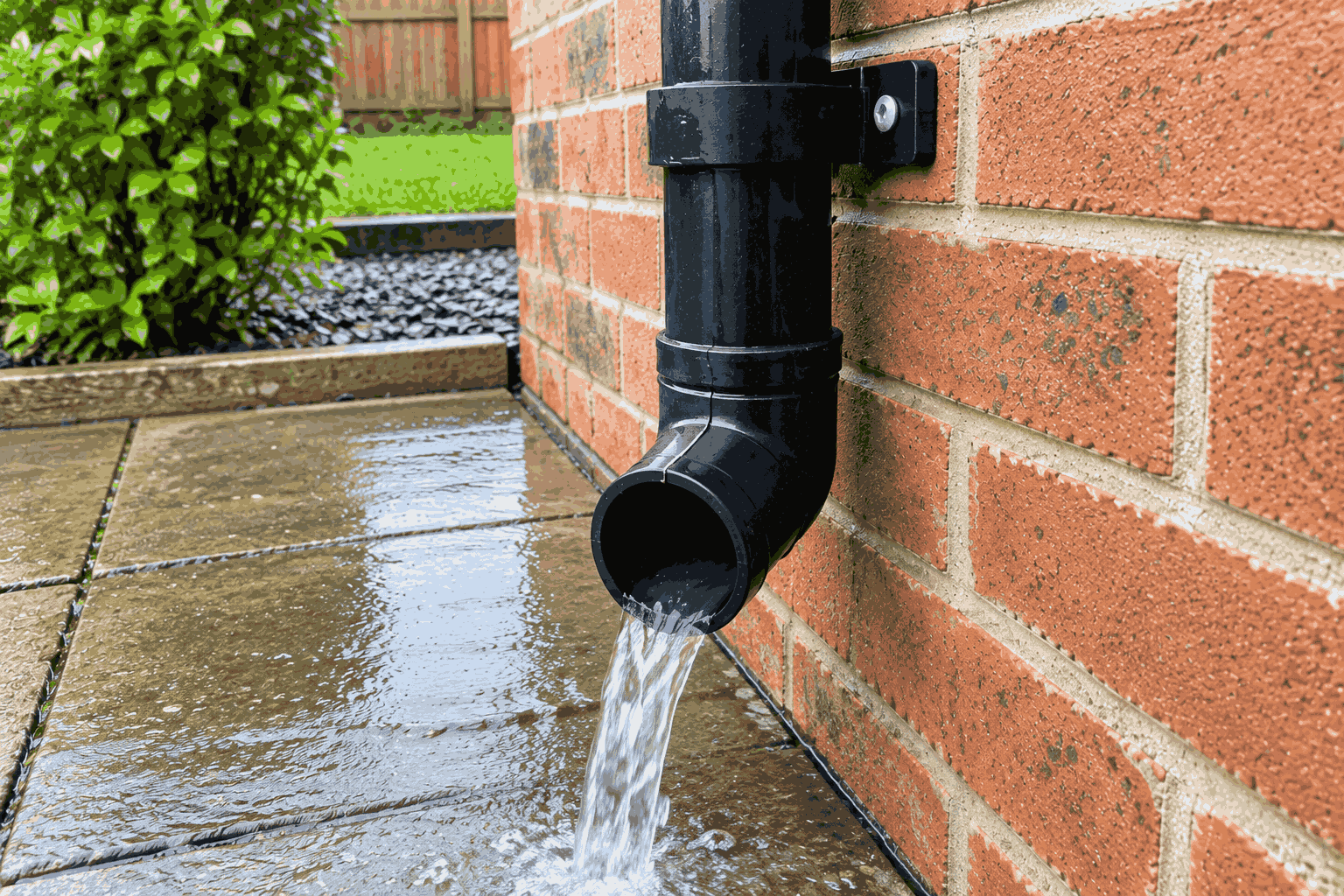 After Unblocking & Flow Test
Why Downpipes Block
The causes are mostly simple. The pattern across them is that a small opening leads to a long path, and anything that does not wash through will lodge somewhere along it:
- Leaves and silt: The single biggest cause. Leaf matter rots into a fine silt that settles in the lowest points of the system. Our guide to leaves in gutters explains what leaves do once they land.
- Moss and roof debris: Moss from the roof, together with granules and grit from ageing tiles, washes down and forms a dense sludge.
- Seeds and plants: Seeds germinate in the silt, and roots can invade the outlet and the pipe. See our guide to gutters full of weeds and seeds.
- Nests and animals: Birds nest in hoppers and the tops of pipes. Insects build in them. Squirrels and rodents sometimes use them as routes into the roof space. Do not disturb an active nest. Active wild bird nests and bat roosts are protected in the UK, so seek advice if you find signs of either. This is a general point, not legal advice.
- Balls, toys and rubbish: Objects thrown or blown onto the roof end up in the gutter and then in the pipe.
- Ice: Water standing in a blocked pipe can freeze and expand. The Walsall Council historic building maintenance guidance notes that “blocked rainwater goods can trap water and in colder conditions this water would freeze and expand”, and recommends checking that downpipes are properly connected to gutters and fixed safely to the wall with a bracket.
- Damaged or collapsed pipe: A cracked, crushed or separated section can trap debris or leak when full. Cast iron can rust from the inside and shed scale into the flow.
- Poor fall or sag: If the gutter above does not fall properly towards the outlet, silt collects and eventually plugs it.
- Overgrown planting and wall climbers: Plants growing up the pipe can squeeze it, hold moisture against it, and drop leaves into the top.
- Diverters and filters gone wrong: A water butt diverter jammed with debris can cause the pipe above it to back up.
- Leaf guards and outlet guards that have blocked: Cage and balloon guards at the outlet can stop big debris, but fine debris still builds up on them.
How to Tell Where Your Blockage Is
You do not need specialist tools to narrow it down. A bit of careful observation tells you a lot, and it helps your cleaner too. Keep to the ground and keep safe:
Watch it in rain
In a decent shower, from a safe, dry place, look at:
- The gutter above the pipe: Is it overflowing at the outlet end? That suggests a blockage at or just below the outlet.
- The pipe itself: Is water running down the outside? Is it dripping from a joint or bracket? That suggests the pipe is full and leaking, which usually means a blockage lower down.
- The sound: A pipe that is silent while the gutter is clearly wet may be blocked. A pipe that gurgles or surges may be partly blocked or backing up from a drain.
- The base: Is water pooling or splashing back at the foot of the pipe? That points to the shoe or the gully.
Look at the staining
The staining pattern tells you where the water has been:
- Stains around a high bracket suggest the pipe has been full to that level.
- Stains from the shoe up the wall suggest backing up from the drain.
- Green streaks below a joint suggest a joint that leaks when the pipe is loaded.
Check the gully
If there is a gully at the base, look at it in daylight. Is there standing water in it after rain has stopped? Is it full of silt and leaves? If so, the blockage may be at ground level. Wear gloves, and if the grid can be lifted safely, check what is underneath. Do not put hands into a drain, and stop if you see anything that looks like sewage.
Listen to the pipe
Some tradespeople tap down a pipe and listen for the change from a hollow to a dull sound, which suggests a blockage at that level. It is not scientific, and cast iron and plastic sound different, but it can help. Do it gently and from the ground.
Use a camera
A camera pole or the camera on a gutter vacuum head can show whether the outlet is clear. This is one of the main reasons ground-based cleaning has changed the job.
Rule out the gutter
If the gutter above is full of debris, clear it first. A clear gutter and a blocked pipe is a different problem from a full gutter and a clear pipe. Our blocked gutters checklist gives you quick diagnostic tests.
How Downpipes Are Unblocked: The Main Methods
There is no single method. The right one depends on where the blockage is, what the pipe is made of and what the blockage is made of:
| Method | Where it works | Strengths | Limits and risks |
|---|---|---|---|
| Ground-based vacuum, from above | Outlet, upper pipe, gutter | Safe from ground; collects debris; camera shows result | Cannot clear blockage deep in pipe, sharp bend or underground drain |
| Hand clearing at the outlet | Outlet, hopper | Direct; simple | Needs access at height; debris can be pushed down pipe |
| Flexible rods or pipe cleaner | Mid-pipe, bends | Can dislodge solid blockages | Can damage plastic joints and push debris into bend if used roughly |
| Plunger or pressure from below | Shoe, lower pipe | Can shift loosely packed debris | Pushes debris up as well as down; can burst joints |
| Dismantling shoe or lower section | Shoe, bottom bend | Gives direct access; thorough | Needs right fittings; older plastic joints may be brittle |
| Water flushing from above | Light blockages | Quick test of flow | Moves debris down and can lodge it in shoe; soaks the wall |
| Drain jetting (high-pressure water) | Underground drain, gully, soakaway pipe | Clears silt and roots in drains | A drainage specialist's job; not appropriate for every downpipe |
| CCTV drain survey | Underground drain | Shows the actual problem | Specialist equipment required |
| Pipe replacement | Collapsed, crushed or corroded sections | Fixes the root cause | A repair, not a clean |
We clear downpipes and check flow as part of our downpipe unblocking service and our gutter cleaning service. Where the blockage turns out to be in an underground drain or a shared sewer, that is a job for a drainage specialist or your water company, and we will tell you so rather than guess.
Most blockages start at the outlet where the gutter feeds into the pipe. A vacuum with a camera clears that area directly and shows you the result. See our guide to gutter vacuum cleaning in Birmingham.
Hosing proves water passes, but doesn't extract debris. Flushing can push loose silt down into a swan neck or shoe where it packs solid. Use water to test after vacuum extraction.
Flexible rods can snag joints or scratch plastic. Pressure from below can lift dirty sludge up into gutters or blow out aged socket seals.
What Not to Do
Some well-meant attempts make things far worse:
Never climb in wet, icy or windy conditions. Our guide to cleaning gutters on a two-storey house safely explains the HSE three-points-of-contact rule.
Striking a pipe cracks brittle uPVC, shatters cast-iron lugs and pulls brackets straight out of Victorian brickwork.
Sudden thermal shock distorts plastic downpipe runs and causes hairline fractures in cold cast-iron sockets.
Caustic chemicals are formulated for foul waste. They dissolve rubber pipe gaskets, attack aluminium, and run straight into surface watercourses.
Stiff coat hangers or fencing wire will puncture plastic bends or snag firmly on joint seams.
A hose left running into a backed-up pipe will flood eaves, fascia boards and internal ceilings once the pipe fills to the top.
Removing the bottom shoe without knowing where the dislodged sludge and backed-up column of water will discharge will drench your foundation masonry.
If the gully contains greywater or foul sewage, stop immediately and contact your water authority or drainage engineer.
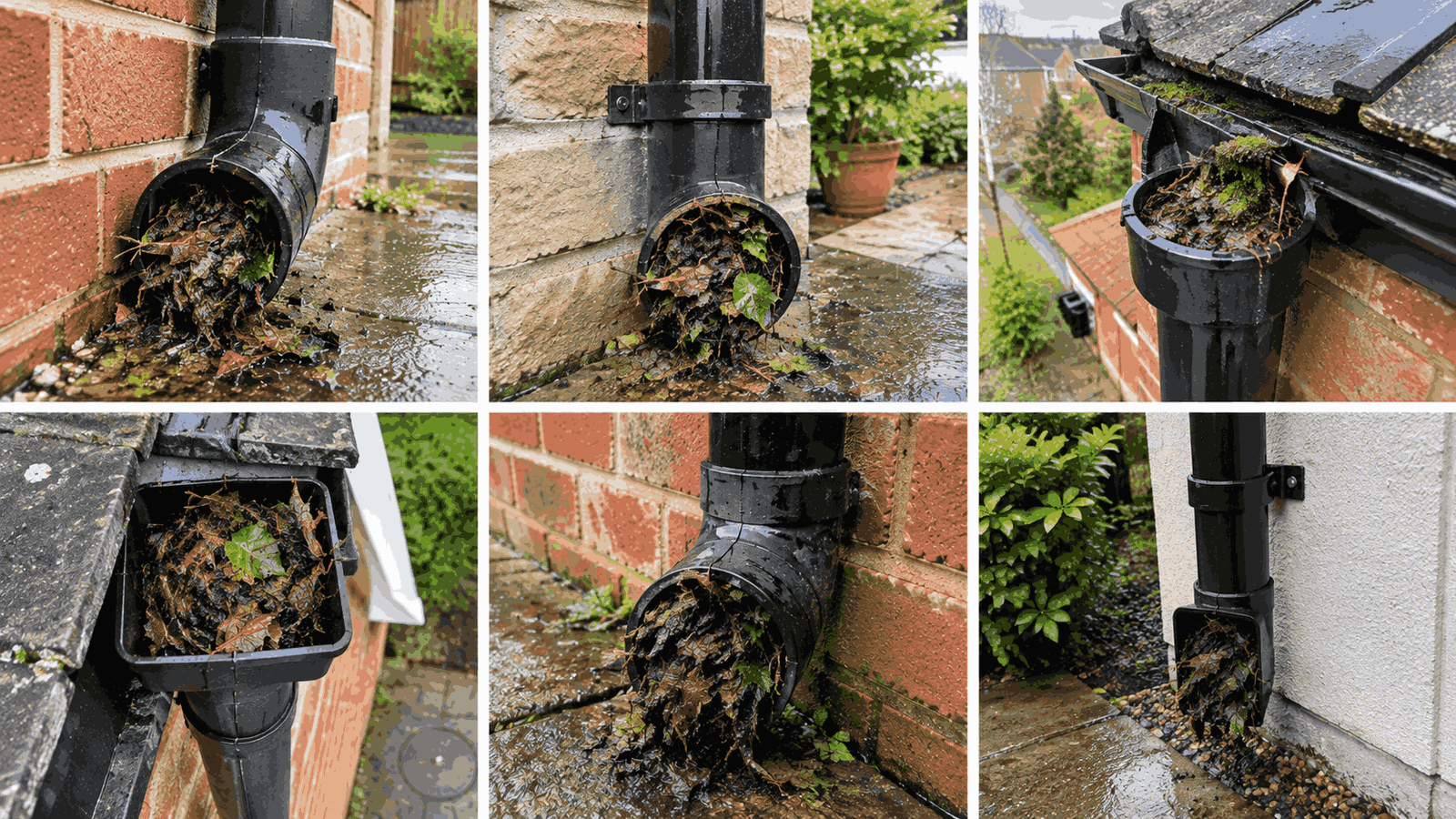
Downpipe Materials & Roof Configurations
Cast Iron Downpipes
Many older Birmingham properties still have cast-iron rainwater goods, and they behave differently:
- Weight: Heavy iron sections strain rusted fixings when loaded with water.
- Internal corrosion: Rust scale inside catches moss and leaves like Velcro.
- Brittleness: A hard knock can snap ears off decorative brackets.
- Failing Putty Seals: Sockets sealed with old putty weep when backed up.
See our dedicated guide to Victorian homes and gutter cleaning in Birmingham.
Square vs Round Profiles & Cascade Roofs
Square plastic pipes have 90-degree internal corners where silt cakes first, whereas round profiles shed debris more smoothly. Cascade layouts—where an upper roof downpipe discharges onto a lower porch, garage or extension roof—concentrate double the volume of debris into the lower pipe run.
Read our guide to bungalow gutter cleaning in Birmingham for details on how attached roofs impact downpipes.
Downpipes and Flat Roofs
Flat roofs drain through small outlets with leaf domes. Internal rainwater downpipes run inside wall cavities and service risers, so the first sign of a blockage can be an unexpected damp patch or ceiling bubble indoors. Ponding water that lingers more than 48 hours after rain signals an outlet restriction.
See our guide to flat roof gutters in Birmingham and our commercial gutter cleaning service.
What Happens at the Bottom & Who Is Responsible for the Drain?
A downpipe is only as good as where it discharges. Surface gullies trap silt in the water seal; soakaways can silt up over decades; and water butt diverters can jam. But when a drain backs up, homeowners often wonder who pays.
Severn Trent's sewer responsibility card shows that the water company is responsible for public sewers, lateral drains, shared sections of sewer and pipe used by neighbours, and pipes outside your property boundary that connect to its network. Highway drains and road gullies are the responsibility of the highways authority. The homeowner is responsible for “waste water pipes within your property boundary that serve only your house.”
Similarly, Stratford-on-Avon District Council's drainage page explains that homeowners are responsible for private drains serving only their property up to the boundary, while Severn Trent Water handles lateral drains and adopted public sewers. Private soakaways remain the landowner's responsibility.
Drainage Responsibility Summary:
- Downpipe on your wall: Yours (or your landlord's / freeholder's).
- Private drain within boundary (sole use): Yours.
- Shared drains, sewers & pipes beyond boundary: Water company (Severn Trent).
- Roadside gullies & street drains: Local Highways Authority.
- Soakaways on your land: Landowner responsibility.
* General descriptions, not formal legal advice. Check your title deeds or contact your water company for boundary specifics.
Urgent or Not? A Triage Guide
“Fast response” is a promise worth being careful with. We don't put artificial callout timers in a guide, but here is how to triage what is happening at your property:
| What you see | How urgent | Why | Suggested action |
|---|---|---|---|
| Water pouring into house / ceiling | Urgent | Active internal damage & electrical danger | Make safe, contain, photo, call for help |
| Water cascading behind pipe in rain | High | Active saturated masonry | Clear the cause promptly |
| Overflow continuing after rain stops | High | Full gutter or backed-up downpipe | Book a vacuum clearance |
| Pipe visibly split, detached or hanging | High | Safety risk & uncontrolled water | Don't lean on it; arrange repair |
| Water pooling at base of wall | Medium to High | Gully or drain backing up | Clear gully; test drain flow |
| Staining at brackets or joints | Medium | Pipe has been holding standing water | Clear and inspect joints |
| Water butt not filling | Medium | Pipe or diverter blocked | Check pipe and clean diverter |
| Slow drainage in light rain | Lower | Partial blockage forming | Book standard clean soon |
| Moss or seedlings at outlet | Lower | Early blockage developing | Book clean before heavy autumn storms |
If active water is entering your home, consult our guide to emergency gutter cleaning in Birmingham after heavy rain and our overview of water damage from blocked gutters.
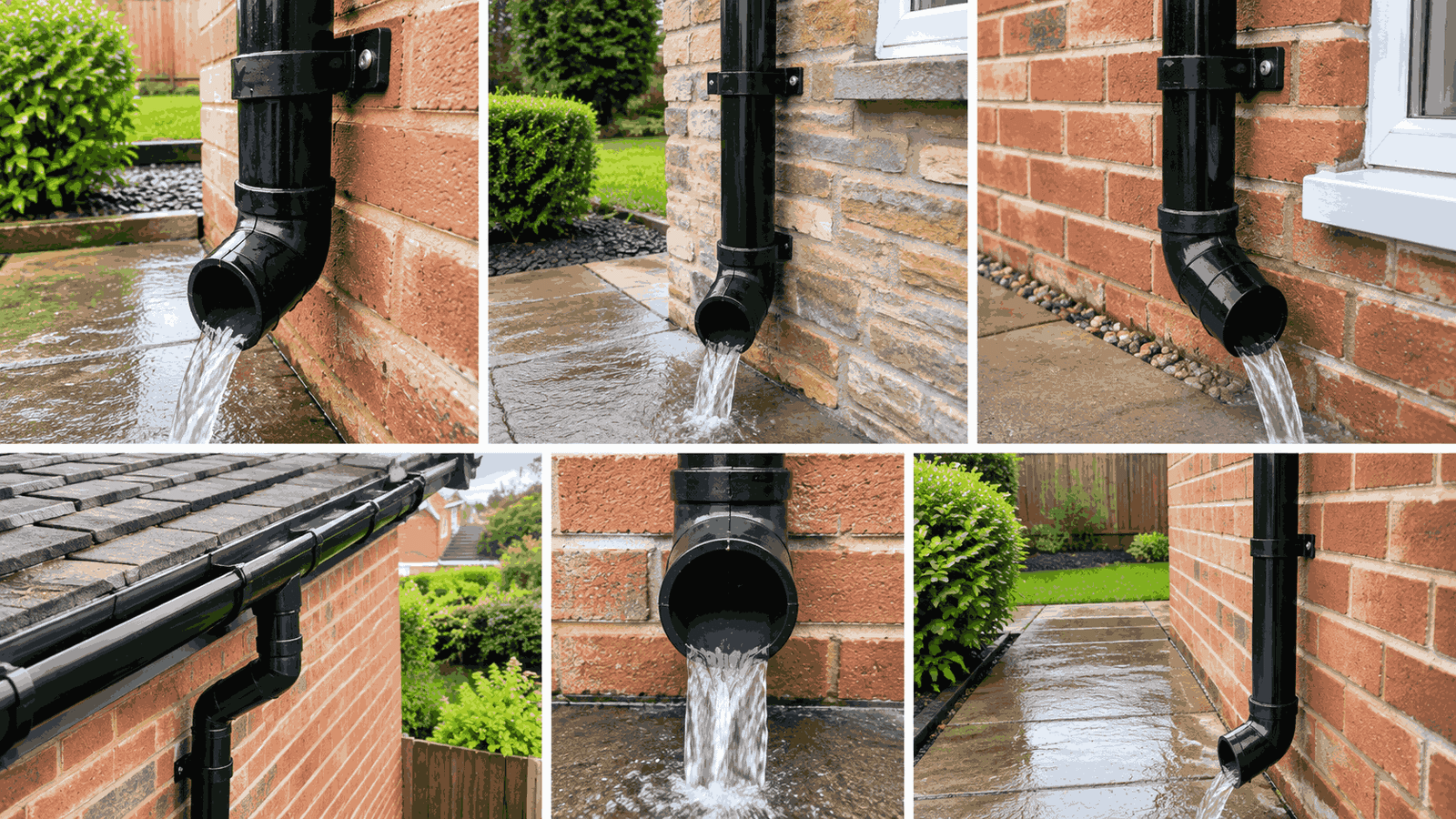
A Worked Example: Tracing One Blockage From Symptom to Cause
It helps to see the reasoning in order. Imagine a semi-detached house in the West Midlands. In a heavy shower, the front gutter overflows at the right-hand corner, and a dark stain has appeared on the brickwork beside the downpipe, level with the first-floor window. The water butt at the side has been empty for weeks:
What a Downpipe Visit With Us Includes
So you know exactly what to expect from our team:
Building height, number of downpipes, blockage location (outlet vs shoe vs drain), pipe material (cast iron requires delicate handling), and property accessibility. For full details, see our gutter cleaning cost guide for Birmingham and our estimate on how long a professional clean takes.
Insurance, Questions to Ask & Red Flags
As an example of insurer terms, Ageas publishes guidance on what is not covered by home insurance claims. It explicitly excludes damage caused by “wear and tear or gradual operating causes” and cites “blockage or cracking of guttering causing damp walls” as a standard uninsurable maintenance issue. Dated invoices and photo proof protect your claims. See our guide to gutter maintenance and home insurance in Birmingham.
A Downpipe Checklist You Can Copy:
Look:
[ ] Photograph downpipe runs from top to bottom
[ ] Check for white or green staining at brackets
[ ] Check for seedlings at the gutter outlet
[ ] Inspect surface gully for standing water/silt
[ ] Watch downpipe during heavy rain
Clear & Record:
[ ] Gutter outlet cleared and checked by camera
[ ] Downpipe cleared and flow-tested with water
[ ] Shoe and surface drain cleared of sludge
[ ] Before & after photos saved with invoice
[ ] Next annual inspection marked in calendar
- Do you clear from the ground or use ladders?
- Do you use a wireless camera to prove the outlet is clear?
- Do you flow-test the pipe after vacuuming?
- What insurance do you hold, and can I see the certificate?
- What guarantee do you provide on clearing work?
- Hammering pipes or forcing stiff rods blindly
- Pouring toxic caustic drain unblockers into downpipes
- Flushing debris downward into an unknown drain
- No before/after photos or reluctant insurance proof
- Immediate pressure to agree to thousands in drain excavation
Downpipe Unblocking Across Birmingham & West Midlands
Frequently Asked Questions
Everything you need to know about blocked downpipes, drainage and unblocking methods
Related Birmingham Reading
Blocked Downpipe? Get It Cleared Safely
We clear downpipes and check the flow from the ground, with no ladders, and we can clean the gutters, fascias and soffits in the same visit. You get before and after photos with every job, a clear note of anything that needs repair, a one-year service guarantee and a fully insured team.