
How Do You Know If Your Gutters Are Blocked? Birmingham Homeowner's Checklist
This checklist focuses specifically on the gutter channel itself — the horizontal run along the roofline — rather than the downpipe running down the wall. If the signs below don't quite match what you're seeing, our separate guide to blocked downpipe signs covers that half of the system in detail, since the two produce genuinely different symptoms and need different checks.
Use this as an actual interactive checklist rather than reading it straight through — most of it can be worked through in five to ten minutes, without a ladder.
Tick the items below as you inspect your property.
Step-by-step diagnostic checklist to identify clogged channels, sagging brackets, and pest infestations.
The 5-Minute Ground-Level Checklist
Start here. All of these are visible from a normal standing position at ground level without needing a ladder:
What to Check From an Upstairs Window or With Binoculars
A slightly closer look, still without needing a ladder, catches signs the ground-level checklist can miss:
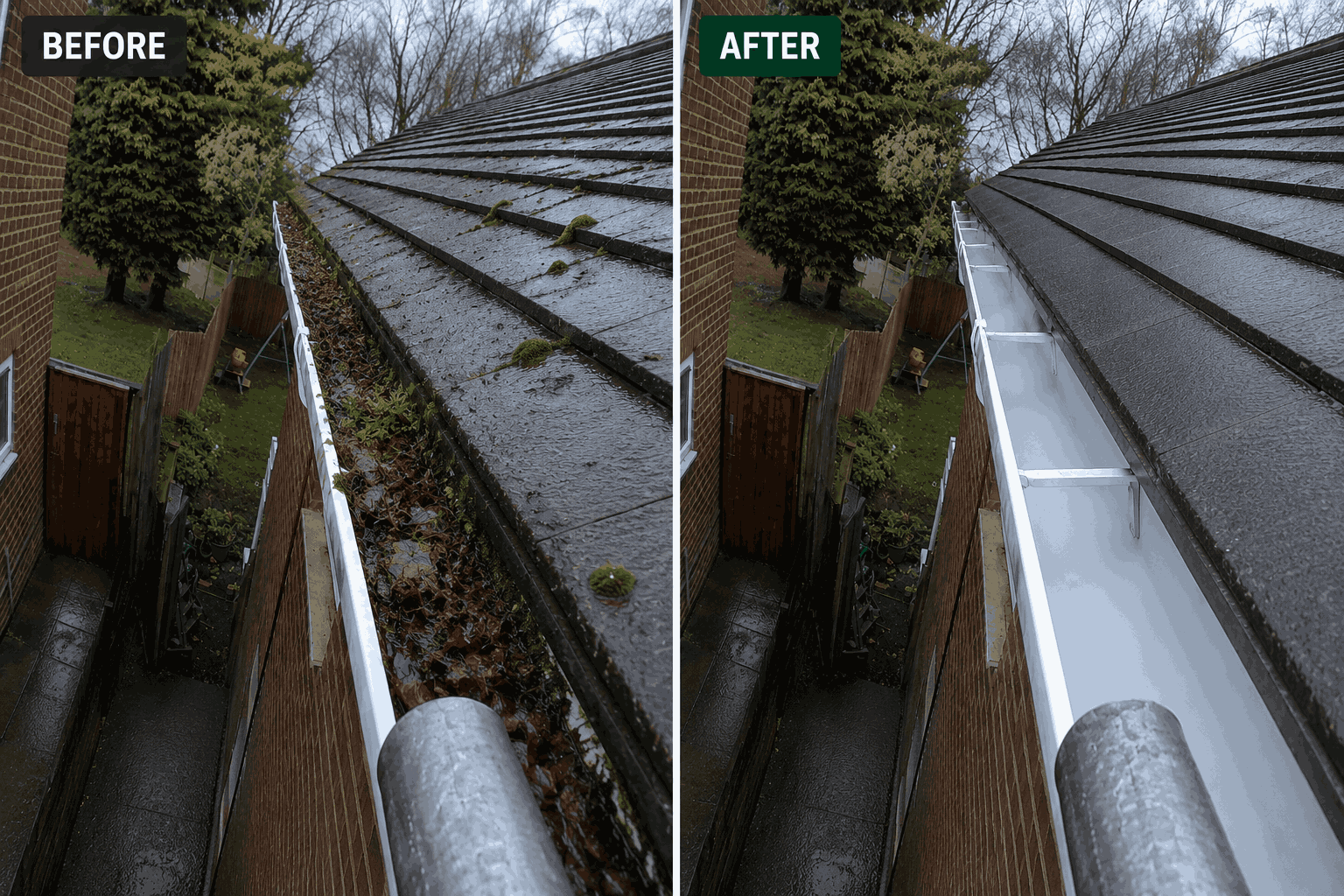
What a Thorough Gutter Inspection & Clearance Accomplishes
See before and after vacuum clearing: decomposing compost sludge removed, unblocking water flow to avoid fascia damage.


Signs You Can Hear Before You Can See Anything
A few signs show up audibly during rain, before any visual inspection reveals the cause:
The Pest Signs Nobody Thinks to Check
A gutter full of debris is genuinely attractive to more than just plant growth. This is worth checking specifically, since these signs are easy to miss entirely if you're only looking for water damage:
Signs Inside the House That Trace Back to a Blocked Gutter
These are easy to attribute to something else entirely, which is exactly why they're worth including here:
Structural Signs Specific to the Gutter Itself, Not the Downpipe
Worth distinguishing clearly, since these point to the gutter rather than anything further down the system:
Signs That Actually Point to the Downpipe, Not the Gutter
A few commonly confused symptoms are worth ruling out here, since they're not actually gutter problems at all:
Empty gutter but persistent overflow
The gutter itself looks empty or lightly debris-covered, but water is still overflowing over the edge — this means water has nowhere to go once it reaches the outlet, which points to the downpipe rather than the gutter.
Standing water pooling at wall base
Water pooling at the base of the wall near the downpipe footing, rather than in the gutter channel itself, indicating a fractured lower pipe or choked ground shoe.
Slow-draining ground gully
A gully at ground level that's slow to drain, even once the visible pipe has been checked, pointing to subterranean soakaway silt blockage.
If these describe what you're seeing rather than anything in the checklists above, our downpipe diagnostic guide is the more useful next read.
A Simple Combined Checklist You Can Run Through Today
Pulling everything above into one quick pass, roughly in the order it's easiest to check:
Common Mistakes People Make When Running This Checklist Themselves
A few specific gaps come up repeatedly when homeowners run through a check like this on their own:
1. Only checking the front of the property
The rear is just as prone to blockage, and on many properties it's actually worse, since it's checked far less often simply because it's less visible day to day.
2. Missing flat-roofed sections entirely
A rear extension or garage roof drains through its own outlet or scupper rather than the main gutter run, and it's easy to check the visible perimeter gutter thoroughly while completely overlooking this separate drainage point.
3. Only checking during or right after heavy rain
Several of the signs above, like standing water that persists once everything else has dried, or plant growth that's rooted rather than just resting on top, are actually easier to spot on a dry day, not during a downpour.
4. Assuming a recent clean means nothing needs checking for a year
A light, quick visual check every few months catches an early developing issue long before the next scheduled full clean would.
5. Overlooking hopper heads and decorative fittings
On older properties, decorative hopper heads can trap debris in the folds and mouldings of the fitting itself, a spot a quick glance at the main gutter run doesn't naturally include.
How Often Is It Worth Running Through This Checklist?
There's no need to treat this as a one-off exercise. A reasonable rhythm for most properties:
Every couple of months
A quick ground-level glance takes under 5 minutes and catches early sagging, staining, or debris before it becomes a genuine problem.
A few times a year
A closer window or binoculars check, particularly for properties near mature trees or with a history of previous overflow.
After noticing anything unusual
An unfamiliar sound during rain, a new damp patch, or unexpected insect activity — check immediately rather than waiting.
Straight after major storms
Heavy wind and storm events often push existing minor silt deposits into full dam blockages.
Properties with heavy nearby tree cover, as covered in our guide to stopping gutters blocking again, genuinely benefit from checking more frequently than this baseline, while a property with minimal nearby debris sources can often manage with less.
When to Book a Professional Check Rather Than DIY
A ground-level and window-based checklist is genuinely useful for deciding whether something needs attention, but confirming and clearing what's actually found often means getting up to the gutter itself — and that's not something to do casually on anything beyond a single storey with safe, stable access.
A professional visit with proper ground-based vacuum equipment can confirm exactly what the checklist above has flagged, clear it properly, and check the downpipe at the same time — covering both halves of the system in one visit rather than leaving the question half-answered.
What This Checklist Doesn't Replace
Worth being upfront about the limits here. Running through this checklist tells you whether something needs attention — it doesn't replace an actual professional clear, and a few things are worth knowing it specifically can't confirm:
- The exact severity of a blockage: A ground-level or window check tells you debris is present, but not whether it's a 5-minute suction or compacted clay silt.
- Downpipe condition below what's visible: Gutter checks don't reveal subterranean soakaway or bend chokes.
- Whether a structural sign is minor or serious: Telling the difference between a simple loose screw and broken fascia timber requires closer inspection.
- Sections of roof genuinely out of view: Hidden extension gutters or runs facing neighbouring gardens require specialized high-reach cameras.
None of this makes the checklist pointless — it is specifically designed to answer "does this need attention at all?" quickly, safely, and without ladders.
Why Catching These Signs Early Genuinely Matters
None of the individual signs above are usually urgent on their own. The value of running through a checklist like this periodically isn't catching a disaster — it's catching something small while it's still small.
The full cost of ignoring a developing issue tends to escalate in sharp jumps rather than gradually, and a five-minute check that catches an early sag or a small patch of moss is consistently the cheapest point in that chain, by a wide margin, compared with any of the stages that follow if it's left unaddressed.
This Checklist Applies Across the Whole Region
The same checks work equally well across Solihull, Sutton Coldfield, Wolverhampton, Walsall, Dudley and West Bromwich — the signs themselves don't change by postcode, though which ones are most relevant does vary depending on property age and guttering material, which is exactly why the Victorian-specific signs above are worth paying particular attention to on the region's older housing stock.
Ticked More Than a Couple of Boxes Above?
Ticked more than a couple of boxes above? Book a full gutter and downpipe check across Birmingham and the West Midlands, with before-and-after photos and a 1-year guarantee.
Frequently Asked Questions
Common homeowner questions about blocked gutter symptoms, inspection routines, and safety
Related Reading in This Series
Explore our complete West Midlands gutter maintenance cluster: