
How Do You Know If Your Downpipe Is Blocked? Signs Birmingham Homes Show
A gutter that's visibly full of leaves is an easy problem to diagnose — you can see it from the ground. A blocked downpipe is a different kind of problem entirely, because the pipe itself is often the one part of the system nobody actually looks at. It runs straight down a wall, mostly ignored, until water starts appearing somewhere it shouldn't.
This guide focuses specifically on the signs that point to a downpipe problem rather than a gutter one, because they're often confused — and treating one as the other means the actual cause never gets fixed.
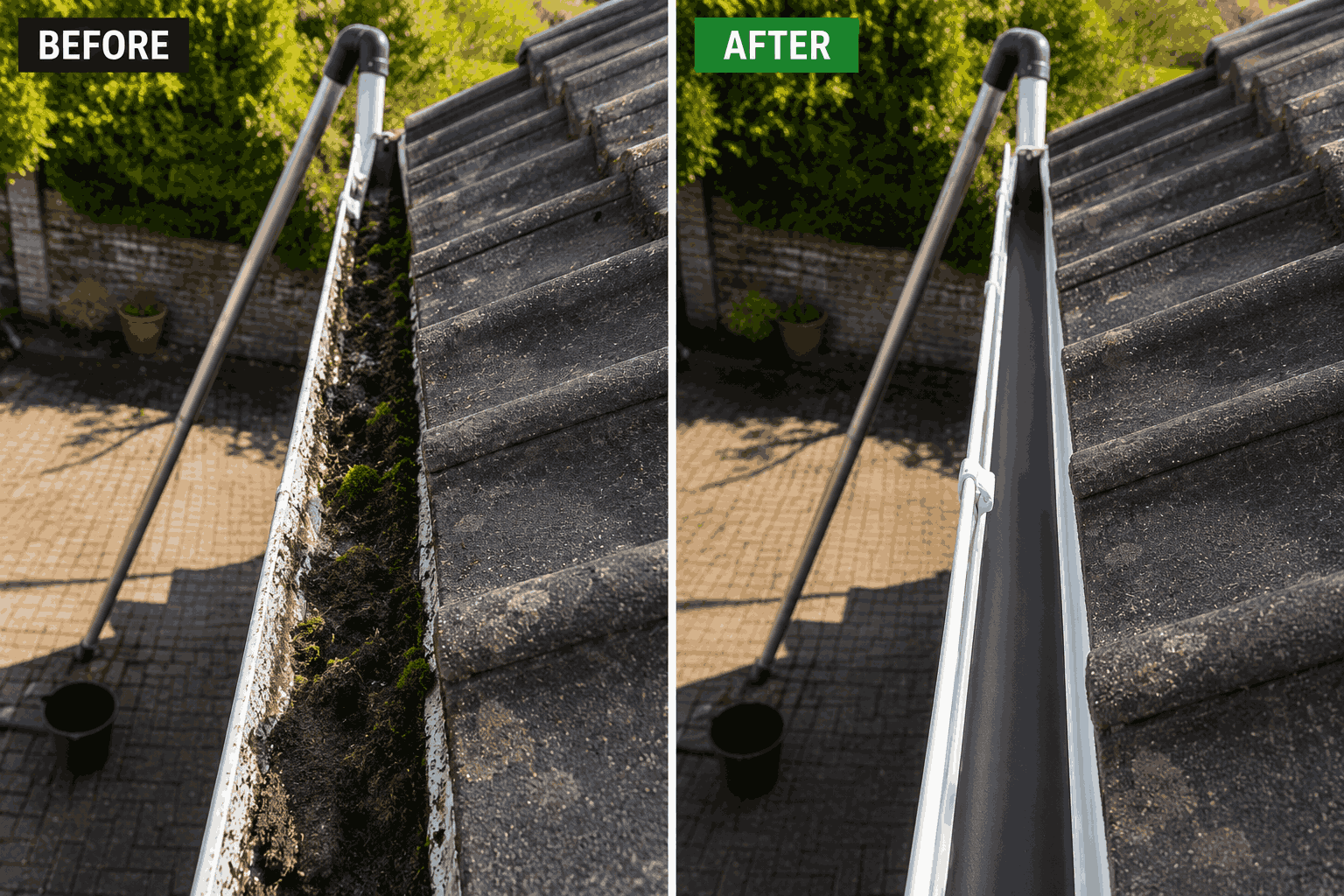
Learn how to distinguish gutter overflow from vertical downpipe and underground drain gully clogs.
The First Question: Is It the Gutter or the Downpipe?
This distinction matters more than most advice acknowledges, because the fix is completely different depending on the answer:
Scenario A: The Gutter Is Full
If the gutter itself is visibly full — leaves, silt, or debris sitting in the horizontal channel — the gutter is the problem, and a straightforward gutter clear resolves the overflow.
Scenario B: Gutter Clean, Still Overflowing
If the gutter looks empty or only lightly debris-covered but water is still overflowing over the edge, the water simply has nowhere to go once it reaches the outlet, which points to the downpipe or the drainage beyond it rather than the gutter itself.
This second scenario catches a lot of homeowners out, because the instinct is to assume the gutter needs another clean when the gutter was never really the issue. A downpipe that's blocked further down — at a bend, an offset, or the connection to the underground drainage — will cause exactly the same overflow symptom as a full gutter, even though the gutter channel is perfectly clear.
Signs at Roof Height and Along the Pipe Itself
Several distinct signs show up before water ever reaches ground level:
Gurgling or Bubbling Sound During Rain
Air trapped behind a partial blockage inside the pipe often makes an audible glugging noise as heavy rainwater tries to force its way past the obstruction.
Water Spilling from a Joint Partway Down
Water escaping from a bracket or push-fit collar partway down the wall — rather than only at the very top or bottom — usually marks roughly where the blockage head sits inside the pipe.
'Waterfall' Effect at a Bend or Hopper Head
The funnel-shaped hopper fitting where a gutter outlet meets the downpipe overflowing violently instead of flowing smoothly downward is a definitive sign of a choke point immediately inside the neck.
Slow, Prolonged Dripping After Rain Stops
A healthy downpipe runs dry shortly after rainfall ceases. Continued slow dripping for hours indicates water is trickling past a dense debris dam very slowly.
Visual Evidence: Blocked vs. Cleared Downpipe Run
Real Birmingham job photography showing ground-level and outlet clearing
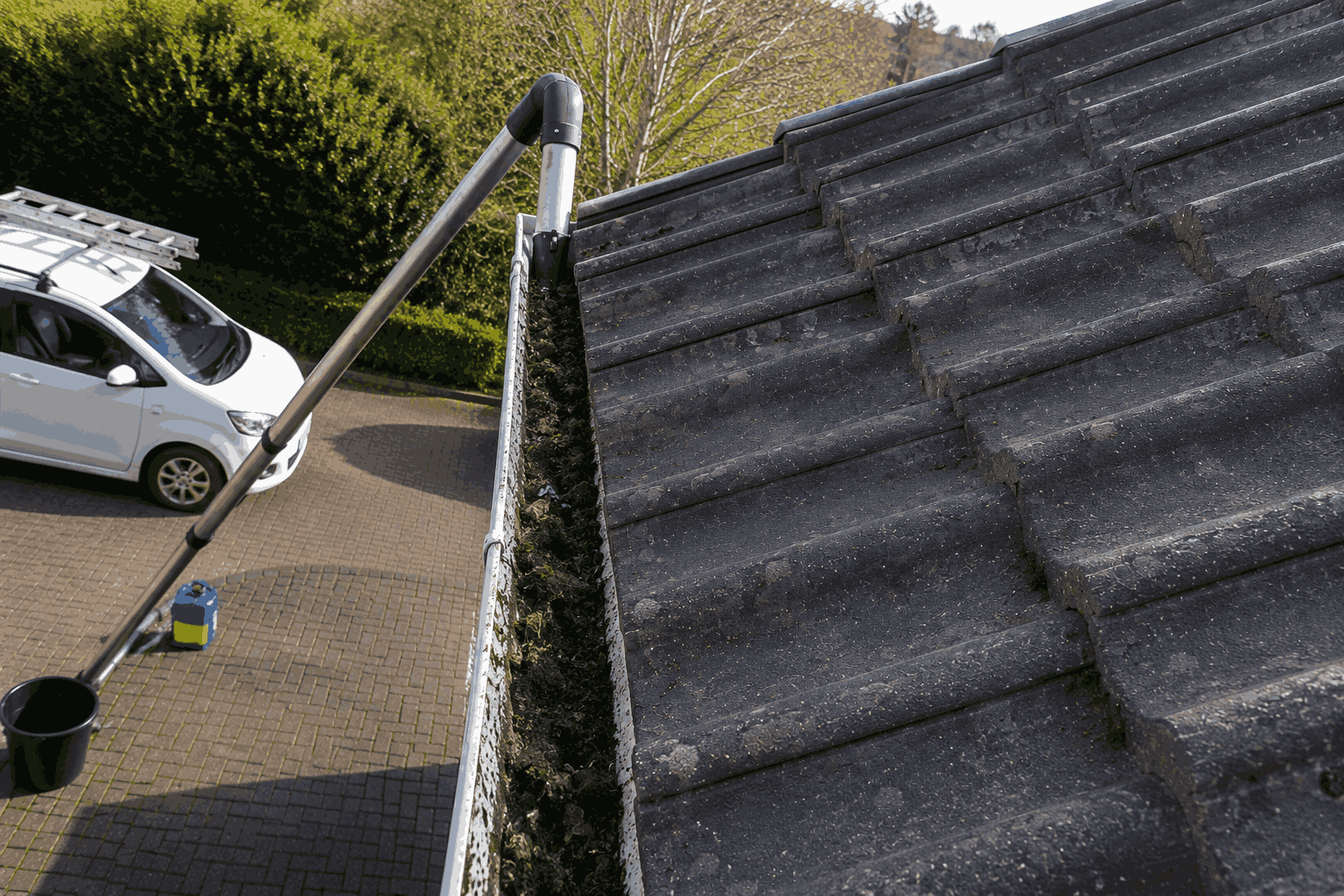
Solid plug of decayed roof moss, grit, and decomposed pine needles completely sealing the top downpipe collar.
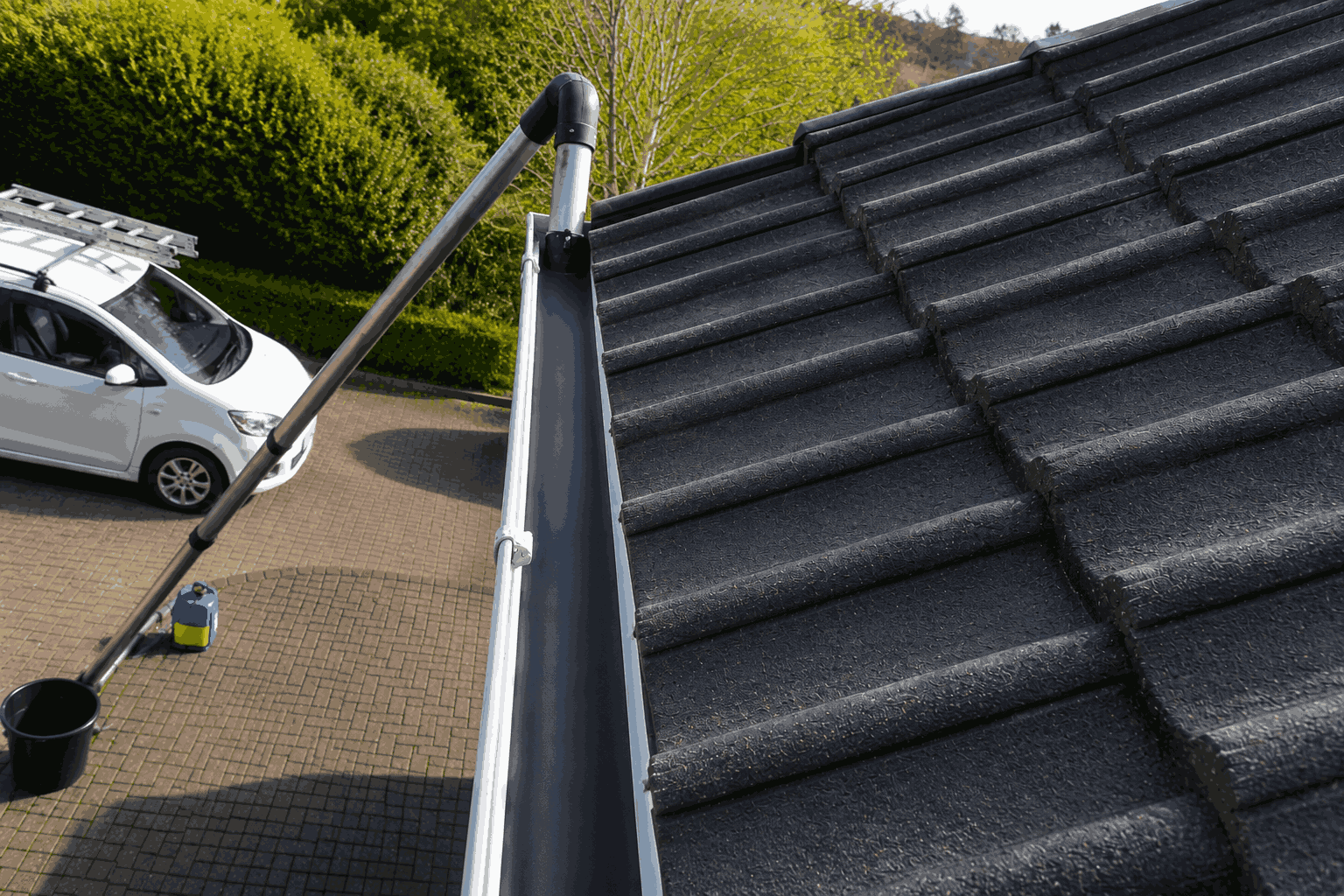
Downpipe flushed clean to ground gully with full 3000W suction and high-volume water flow verified.
Signs at Ground Level, Where the Downpipe Meets the Drainage
This is where a lot of the most reliable diagnostic evidence actually shows up, and it's the part most generic gutter-focused advice skips over entirely:
- Standing water pooling: Rainwater pooling around the base of the downpipe long after rain has passed, rather than soaking away immediately.
- Overfilling gully: A gully — the small grated trap drain most downpipes empty into — that fills rapidly and refuses to clear even during light drizzle.
- Damp patches & efflorescence: Dark damp staining or white salty mineral deposits on external brickwork directly behind or alongside the lower pipe.
- Algae & lush plant growth: Concentrated moss, bright green slime, or thriving weeds around the shoe fitting, demonstrating ongoing saturation.
- Persistent foul or stagnant smell: Anaerobic decomposition of trapped organic mulch inside the gully or bottom swan neck produces a distinct sour odour.
The Distinction Most Advice Misses — Above-Ground Pipe vs. Below-Ground Drainage
Here's the part that trips up almost every generic gutter guide: the visible downpipe running down the wall is often only half the system. At the bottom, it typically connects to a gully — a small trapped drain set into the ground — which then feeds into underground pipework running to a soakaway or the main municipal drainage network.
A blockage can sit in any of these three distinct locations, and the ground-level symptoms don't automatically tell you which one:
Visible Pipe Itself
Debris stuck at swan necks, bends, or shoes. Easily cleared during a standard maintenance visit with high-suction vacuum tools.
Ground Drain Gully
Silt and leaf mulch sitting in the small grated trap. Easily checked by lifting the grate and clearing out the water trap chamber.
Underground Run
Collapsed pipe, backfall, or tree root ingress beyond the gully. Invisible without specialist CCTV survey equipment.
Why This Matters More on Older Birmingham Properties
Much of Birmingham's Victorian and Edwardian housing stock — alongside older properties across Solihull and Sutton Coldfield — still runs on original vitrified clay underground drainage pipework, sometimes over a century old.
Clay pipework develops hairline cracks and loose mortar collar joints over time. Those tiny gaps are exactly what draws in searching tree roots, which then proliferate inside the warm, moist pipe and create massive fibrous root balls. This is a genuinely common issue on older West Midlands properties with mature street trees, and it produces the exact same ground-level symptoms as a simple gully blockage — standing water, a slow-draining gully, and rising damp at the base of the brickwork.
Newer properties aren't completely immune either — modern plastic underground drainage can still develop misaligned push-fit joints or a crushed section from ground settlement or heavy driveway vehicle parking, though it is far less prone to root intrusion than older clay systems.
Simple Checks a Homeowner Can Safely Do
A few simple, practical tests help narrow down where a suspected blockage actually sits, without needing expensive equipment or climbing ladders:
1. The Watering-Can Test
Pour a reasonable volume of water into the top of the downpipe (or gutter outlet) and watch the exit. Water that drains promptly suggests a clear pipe; delayed or missing water proves an internal obstruction.
2. Lifting the Gully Grate
Lift the metal or plastic grate at the base of the pipe to check for a thick bed of leaves, roofing grit, or silt sitting in the water trap chamber — often the fastest, most conclusive check.
3. Acoustic Pipe Tapping
Tap gently with a coin or small wooden block along the visible vertical run. A hollow ring indicates free space, while a dull, solid thud pinpoints the exact height of the trapped debris clog.
4. Drainage Timing Check
Note how long the pipe drips after rain. A healthy system dries up within minutes; persistent dripping for 3 to 6 hours signals severe flow restriction.
When It's Time to Call a Specialist Rather Than a Gutter Cleaner
A standard gutter cleaning and downpipe clearing visit covers the visible pipe and the gully at the base — clearing debris, checking the connection, and confirming water flows through properly. That's the right scope for the vast majority of blockages, which sit in one of those two places.
It's a different job entirely once the evidence points underground. Signs worth treating as a cue to bring in a drainage specialist rather than booking another standard clear include:
This is a genuine scope boundary worth being upfront about: clearing a visible downpipe and gully is straightforward maintenance; diagnosing and repairing damaged or root-infested underground pipework is specialist drainage engineering work, and conflating the two rarely ends well for the homeowner's budget.
What Happens If a Blocked Downpipe Is Left Unaddressed
The consequences of a persistently blocked downpipe are somewhat different from a blocked gutter, because the failure point sits lower down the building, much closer to the foundations:
Brickwork Saturation
Repeated saturation at the base of external walls accelerates spalling brickwork, mortar decay, and blown render at ground-floor level.
Foundation Subsidence Risk
Water pooling repeatedly at one fixed ground point softens subsoil, contributing to localised ground movement over time near load-bearing footings.
Internal Penetrating Damp
Moisture migrates through solid brick courses into ground-floor living rooms, causing peeling wallpaper, mould, and skirt rot.
False Gutter Recleaning Costs
Repeatedly paying for gutter cleans when the underlying issue is a downpipe or drainage restriction that gutter clearing cannot fix.
What a Thorough Downpipe Check Should Actually Cover
A professional downpipe service must not stop at the roofline. A complete, professional check covers:
This Applies Across the Whole Region
The same diagnostic principles hold regardless of postcode across Wolverhampton, Walsall, Dudley, West Bromwich and the wider West Midlands — what changes locally is simply how likely underground root ingress is, given the region's mix of older clay-pipe housing stock and mature street trees.
A DrainBoss guide on blocked downpipe causes makes a similar point for UK properties generally: recurring blockages are frequently traced back to the gully or the underground drain rather than the downpipe itself, which is exactly why identifying where a blockage actually sits matters more than simply clearing whatever's visible and hoping it doesn't come back.
Does the Downpipe Material Change What You're Looking For?
Birmingham's mixed housing stock means downpipes vary quite a bit in material, and that affects which signs matter most:
Cast Iron Downpipes (Victorian & Edwardian)
Show a distinct additional warning sign beyond blockage symptoms: rust staining running down the outside of the pipe, or a section that looks visibly thinner or flaking. A cast iron pipe can develop a genuine hole from corrosion, which produces a leak that looks similar to overflow from a blockage but has a completely different cause and fix.
Original uPVC Downpipes (1970s–1990s)
Can become brittle with prolonged UV exposure, making cracked sections or a joint that has pulled slightly apart more likely than on a newer installation, even without a blockage present.
Modern uPVC and Seamless Aluminium
Generally more resistant to material degradation, meaning symptoms almost always point directly to an internal organic blockage rather than structural breakdown of the pipe itself.
This matters diagnostically: on an older cast iron pipe, it's vital to distinguish between “water is escaping because something is blocked further down” and “water is escaping because the pipe wall has corroded through.” The ground-level symptoms can look almost identical, but one is solved by clearing a blockage and the other needs the pipe repaired or replaced.
Related Signs Worth Checking at the Same Time
A downpipe rarely fails in complete isolation from the rest of the system feeding into it. When investigating a suspected blockage, it's worth glancing at two related areas while already checking:
Fascia Boards & Soffits
Staining or rot directly above the hopper head or gutter outlet feeding the downpipe confirms the overflow has been occurring repeatedly over several months, not just during the most recent rainfall.
Roof Moss & Tile Sludge
A heavy moss patch shedding material into the gutter is a common source of debris that ends up settling in a downpipe bend. A roof and moss check addresses the root cause as well as the symptom.
Commercial Properties and Shared Drainage Runs
Commercial buildings often have several downpipes feeding into a shared underground drainage manifold rather than each pipe having its own independent route to a soakaway.
This means a single underground restriction can affect multiple downpipes at once, producing simultaneous overflow at several points around a building — a pattern that's a strong indicator the problem sits in the shared underground section rather than in any one individual pipe. This should be flagged to the building facilities manager immediately rather than treating each pipe as an isolated problem.
Frequently Asked Questions
Not Sure If It's the Gutter, the Downpipe, or Underground?
Book a full downpipe and gully check across Birmingham and the West Midlands, with an honest, expert answer about what's actually causing the overflow. Zero ladder contact, £5M insurance cover, and camera proof.
✓ Full downpipe flushing · ✓ Gully check included · ✓ £5M Public Liability Cover · ✓ Serving all B, WS, WV, DY & CV postcodes