
A drip is one of the smallest signs a gutter can give you, and one of the most useful. It might be a single bead of water hanging from a joint on a dry afternoon. It might be a dark line running down the brickwork from the same spot every time it rains. It might be a green patch on the wall where the wetness has been going on for years.
Whatever form it takes, a dripping joint is the gutter telling you where it is failing. The joint is where two parts meet, and every joint depends on a seal, a gasket, a bolt, a bead of putty or a snug fit that can wear, dry out, shift or fill with debris. When it fails, water takes the shortest path to the ground, and that path is usually your wall.
This guide is about those joints. It explains what a gutter joint is made of, why joints drip, how to tell a joint problem from a blockage or an overflow, what sealing can and can't fix, how different materials (plastic, cast iron, aluminium) need different treatment, what you can safely check from the ground, when to call someone, and how to keep joints dry for longer. It is written for homeowners, tenants, landlords and managers across Birmingham and the West Midlands, and it is meant to be useful whatever the time of year.
If you have a dripping joint now and want the gutters cleaned from the ground with no ladders, the joints photographed and a clear note of what needs sealing or replacing, you can call 0333 8804129 or request a free quote online.
How This Guide Fits With Our Other Articles
We have written about gutters from several angles, and this one has a narrow focus on purpose.
- Our guide to leaking gutter repair in Birmingham is the broad view: whether to fix or replace a leaking system.
- Our guide to overflowing gutters is about water going over the front of the gutter.
- Our guide to downpipe unblocking is about the pipe.
- This guide is about the joints: what they are, why they drip, and what actually stops it.
What Counts as a Gutter Joint?
A gutter system is made of parts, and every place two parts meet is a joint. In an ordinary house there may be a dozen or more.
| Joint | Where it is | Common problem |
|---|---|---|
| Union joint | Between two lengths of gutter | The seal wears or the lengths drift apart |
| Corner (angle) joint | Where the gutter turns a corner | Movement and loaded debris strain the seal |
| Stopend | The cap at the closed end of a run | Drips at the cap, especially if the fall is wrong |
| Outlet | Where the gutter meets the downpipe | Leaks around the outlet from blockage or a poor fit |
| Downpipe socket | Between sections of downpipe | Drips when the pipe is full |
| Offset or swan neck | Bend carrying the pipe round the eaves | Debris catches, and the joints leak when loaded |
| Bracket or clip | Fixing at the fascia | Not strictly a joint, but a loose bracket opens the one beside it |
| Hopper head | Box at the top of some older downpipes | Overflows and leaks at its joints |
| Cast-iron socket joint | Where one cast-iron length fits into the next | Putty dries and cracks, bolts rust |
| Lead or sealed repair | Patch repairs on older systems | Failed patch, new gap |
When someone says "the gutter is dripping", the real question is usually which of these is the culprit.
The Anatomy of a Plastic Gutter Joint
Most modern homes in Birmingham have plastic gutters, normally with a clip or union that holds two lengths together. Manufacturers describe the principle simply. One retailer's description of a replacement part for FloPlast gutters calls it a "strong replacement wrap-around clip with rubber gasket for securing and sealing weakened gutter joints", explains that "these rubber gaskets fit to the inside of gutter parts, to create the seal between them and the guttering lengths", and says the clip "wraps around unions, corners, stopends etc, to provide a strong watertight guttering joint". See the FloPlast clip and rubber gasket listing . The same guidance advises removing any existing clip and gasket, cleaning the part thoroughly and fitting a gasket to each gasket channel before raising the part to the gutter.
That tells us three useful things:
- The seal in a plastic joint is usually a rubber gasket, not glue or sealant.
- The gasket and clip are separate, replaceable parts, and are often replaced together.
- A thorough clean before refitting is part of the repair. A gasket pressed onto a dirty or silted surface will not seal properly.
Compatibility matters, because gutter profiles are not interchangeable. A square, half-round or ogee profile from one manufacturer may not suit another. A tradesperson who knows the system, or who matches a profile before ordering, saves time and avoids a second leak.
The Anatomy of a Cast-Iron Joint
Older homes in Birmingham, particularly Victorian and Edwardian ones, often still have cast-iron rainwater goods. Their joints work differently. Sections are typically connected with a socket or flange and held with bolts, with a sealing material between the faces.
The Welsh heritage body Cadw gives clear guidance on what to do when these joints leak. It advises to "search for signs of leakage and where possible clean and reseal leaking joints", says that "silicone sealants may be used as a temporary repair", and says the preferred method is for leaking joints to be taken apart, "cleaned, de-rusted, reassembled and sealed using traditional linseed oil putty". It also warns that cast iron "will shatter if it is struck hard", advises repairing where possible and replacing severely rusted or split sections "on a like-for-like basis", and says extruded aluminium and UPVC are not suitable substitutes for cast iron on historic buildings. It recommends removing rust and repainting on a cycle of "3 to 4 yearly" or sooner if corrosion appears. See Cadw's published guidance on rainwater disposal . Cadw is the Welsh Government's historic environment service, so its guidance is written for historic buildings, but the principles of cast-iron care apply anywhere.
Two practical points follow:
First, a proper cast-iron joint repair is not a quick squirt of sealant. It is a small job of disassembly, cleaning and resealing. Second, a silicone bead can stop a drip for a while, but even heritage guidance treats it as a temporary measure.
Our guide to Victorian homes and gutter cleaning in Birmingham explains why older rainwater goods need gentle handling.
Other Materials Across the West Midlands
- Aluminium: Durable and resistant to rust. Joints are usually sealed with a sealant and fixed with rivets or clips. Dents, thermal movement and failing sealant are typical causes of drips.
- Galvanised steel and older metal: Joints may be lapped and sealed. Corrosion can open them. Rust is a sign the system may be near the end of its life.
- Timber and lead-lined gutters: Found on some very old or specialist buildings. Bradford Council's guidance for owners of older buildings advises that lead-lined gutters should be checked "particularly the joints for leakage regularly" and that timber and cast iron should be "regularly painted" to prevent decay and rusting. See its rainwater goods guidance . These are specialist systems, and repairs should be made by someone with relevant experience.
- Asbestos-cement: Some very old rainwater goods and roof sheets may contain asbestos-cement. If you suspect it, don't drill, scrub or break it, and get professional advice before any work. This is general safety information, not a diagnosis.
Why Gutter Joints Drip: 12 Real Causes
A joint can fail in many ways. Knowing which one you have decides the fix.
The seal has aged
Rubber gaskets and sealant dry, harden and shrink over the years. A gasket that once sat snugly leaves a hairline gap that weeps in rain.
The joint has moved
Gutters expand and contract as temperatures change, and brackets loosen with time. A joint that was tight when installed can drift apart.
The run has sagged
A dip in the gutter loads the joint nearest it. Water and silt collect at the low point, and the extra weight opens the seam.
Debris holds water against the joint
A joint that sits in a bed of wet silt leaks more readily than one that drains clear.
The fall is wrong
If the gutter does not slope to the outlet, water stands in it and finds every imperfection. Standing water is the real cause of many joint drips.
The joint was badly made
A gasket missing, twisted or not seated properly, or a clip that was never fully closed, will leak from the first rain.
The parts do not match
Mixed profiles or brands can leave a joint that looks right but cannot seat or seal correctly.
Sealant applied where it does not belong
Sealant slapped over a dirty, wet joint rarely bonds, and it can hide a failing gasket that should have been replaced.
Rust or corrosion
In cast iron and steel, rust opens joints from the inside, and bolts seize or snap.
Impact or mechanical damage
A ladder knocked against a gutter, a heavy branch or a thrown ball can crack a union or twist a joint.
Blockage upstream
A blocked outlet or downpipe backs water up to the joints, which then leak because they are full. The drip is a symptom, not the cause.
Freezing water expansion
Water trapped in a blocked gutter or pipe can freeze and expand and strain the joints.
Walsall Council's historic building maintenance guidance notes that "blocked rainwater goods can trap water and in colder conditions this water would freeze and expand". See the Walsall Council historic building guidance . Many dripping joints turn out to have two or three of these working together: an ageing gasket, a slight sag and a bed of silt. That is why cleaning is almost always the first step.
Drip, Overflow or Blockage? Telling Them Apart
Three different problems look similar from the garden, and mixing them up leads to the wrong repair.
| Feature | Dripping joint | Overflow | Blocked downpipe |
|---|---|---|---|
| Where water appears | At a seam, union, corner or stopend | Over the front or back edge, along the run | From the joint or bracket on the pipe, or at the base |
| Pattern | Same spot every time | Lowest point or the end nearest the outlet | Often at the pipe's weakest joint |
| In light rain | Often still drips | Usually fine | Often fine |
| In heavy rain | Drips more | Spills badly | Pipe leaks and gutter backs up |
| After rain stops | May keep dripping for a while | Stops quickly | Pipe may keep running or stay full |
| Staining | Narrow line below the joint | Broad streaks below the edge | Staining around brackets and the base |
| Likely cause | Seal, gasket, movement, sag | Silt, debris, poor fall | Blockage in the pipe, shoe or drain |
| First step | Clean, then inspect the joint | Clean the gutter run | Clear the pipe and check flow |
If you are not sure which you have, a clean and a flow check usually settles it. Our guides to overflowing gutters and blocked downpipe signs go through each in detail.
Where the Drip Is Tells You What Is Wrong
You can learn a lot from the position of a drip, without leaving the ground.
- At a union: Usually the gasket has aged, the clip has loosened, or thermal movement has pulled the ends apart.
- At a corner: Corners take the highest movement and debris strains. The angle fitting may be stressed.
- At a stopend: Check whether the gutter sags towards the closed end instead of the downpipe.
- Around the outlet: Debris commonly lodges here, backing water up until it breaches the seal.
- At a downpipe socket: Points to water backing up inside the vertical pipe due to a blockage further down.
Cadw's guidance on cast-iron rainwater goods lists the signs to look for on the wall below a leak: rust and water stains, washed-out mortar joints, and moss or algae growth, and adds that holes at the back of downpipes are easy to miss. If you see these signs, the wall deserves a closer look. White salts (efflorescence) left on brickwork indicate water is repeatedly soaking the masonry and drying out.
A Simple Test You Can Do Safely
You can learn a lot from watching a drip, without ever touching a ladder:
- Pick a dry spell: Look at the suspect joint from the ground with your phone zoom or binoculars. Is it already wet, stained or dripping?
- Watch in rain: From a dry, safe position, look at whether the drip is steady, speeds up or only happens in heavy rain.
- Look after rain stops: Does it keep dripping for several minutes? That suggests water is trapped above.
- Check the low spot: Is there a dip in the run near the joint? Look along the gutter from the side.
- Photograph it: Take a close shot and a wider shot, with the date.
Safety Rule: Do not climb up to feel the joint or pour water on it from an upstairs window. If you want to confirm flow, our ground-based team runs high-reach vacuum clearing and flow checks safely.
Visual Evidence: Leaking Joints Repaired
 Before: Dripping Joint
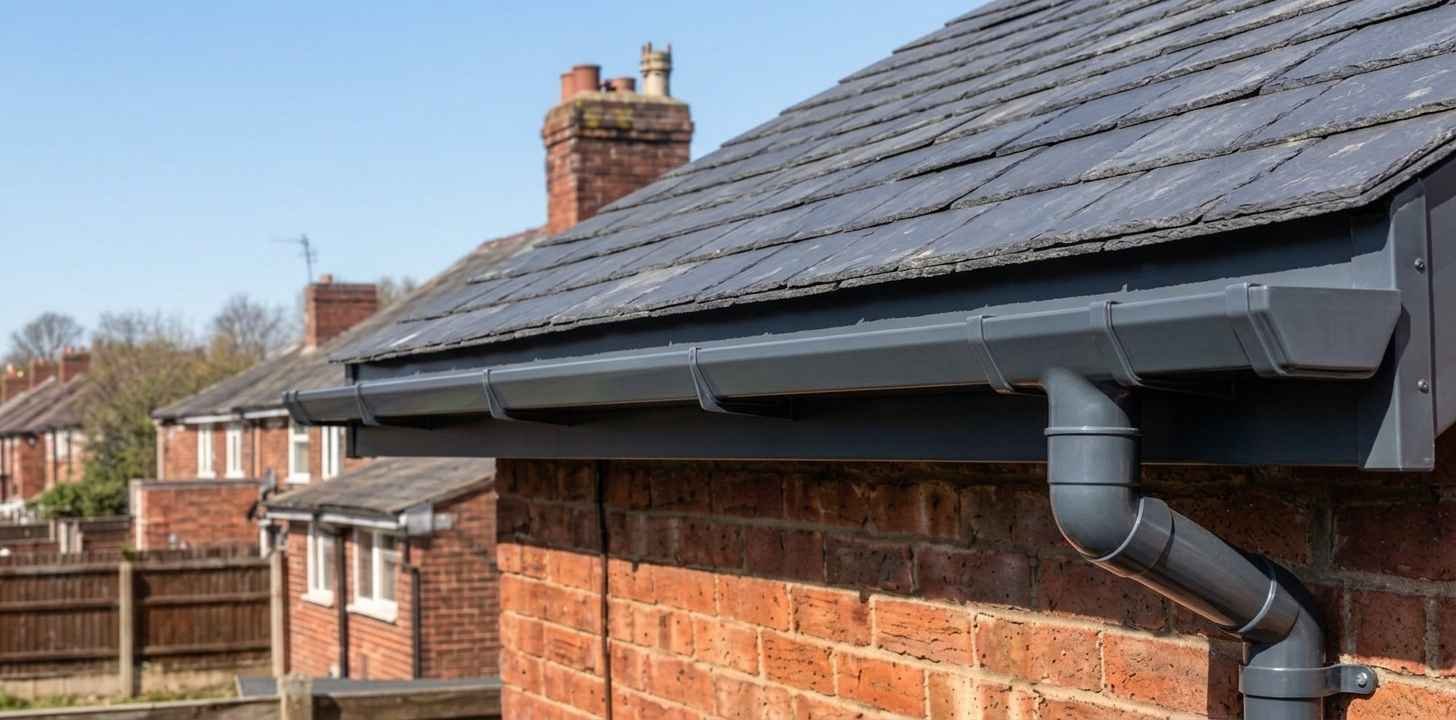 After: Resealed & Flow Tested
What Sealing Can and Can't Fix
Sealing is a useful tool when the problem really is a failed seal. It is the wrong tool in many other cases.
Sealing Can Help When:
- • The gasket or sealant has aged but parts are sound and aligned.
- • The joint is clean, dry and the surfaces are intact.
- • The leak is slight and the gutter drains properly.
- • You need a temporary measure until a proper overhaul is done.
Sealing Will NOT Fix:
- • A sagging run that holds water at the joint (fall needs correcting).
- • A cracked or split part (needs replacement).
- • A blocked outlet or downpipe causing overflow into joints.
- • Rust-through in cast iron or steel.
- • Mismatched parts that cannot seat properly.
- • A joint packed with silt or loose brackets.
Sealant applied to a dirty, wet or moving joint tends to fail quickly, and it can hide the real fault until it fails again. Manufacturers' instructions and heritage guidance point to the same order: clean thoroughly, then replace the seal or reseal.
The Repair Ladder: From Simplest to Most Involved
A good tradesperson works up this ladder, and stops at the first rung that works:
Clean the gutter and joint
Remove silt, moss and debris. Often reveals the true extent of the problem and sometimes stops the drip immediately.
Check the fall and the brackets
Refix sagging sections and loose brackets so water drains freely to the outlet.
Re-seat the joint
Take the parts apart, clean both mating surfaces and put them back together squarely.
Replace the gasket and clip
For plastic systems, a new rubber gasket and wrap-around clip are often the proper permanent fix.
Reseal with a suitable sealant
For certain materials or as an interim measure, strictly following the manufacturer's prep instructions.
Replace the part
A cracked union, corner, stopend or outlet needs a matching new component.
Replace a section
When a gutter length is split, corroded or distorted beyond true alignment.
Replace the run or system
When failure is widespread across old, degraded goods and piecemeal repairs become endless.
Because step 1 is a clean, our ground-based service is usually where this ladder starts. See our gutter cleaning service and our guide to gutter vacuum cleaning.
Fixing a Plastic Gutter Joint: What the Job Involves
This is a description of what a competent tradesperson does, not a DIY recipe, because most of it is done at height:
- Make the area safe with secure access and check for overhead cables.
- Clear the gutter on both sides of the joint.
- Release the clip and separate the parts.
- Remove the old gasket and clean the channel and the gutter ends thoroughly.
- Check the parts for cracks, warping and fit. Replace any that are damaged.
- Fit a new gasket into its channel, as the manufacturer describes.
- Re-seat the gutter ends squarely and close the clip fully.
- Check the brackets either side and the fall along the run.
- Run water through to confirm the joint is dry.
- Photograph the finished joint for records.
Fixing a Cast-Iron Gutter Joint: What the Job Involves
Cadw's description gives the outline: take the leaking joint apart, clean and de-rust it, reassemble and seal it using traditional linseed oil putty. In practice that also means:
- Support the gutter so the section does not drop when bolts are released.
- Remove bolts with extreme care; cast iron is brittle and will shatter if struck hard.
- Separate sections gently and wire-brush/clean the mating faces.
- Check for cracks and thinning; replace cracked sections like-for-like.
- Reassemble with new stainless or galvanised bolts and linseed oil putty.
- Repaint the repaired area once ready (Cadw recommends a 3 to 4 year cycle).
- Test the flow thoroughly.
Our guide to Victorian homes and gutter cleaning explains why older metal goods require specialised care.
Downpipe Joints: The Ones Nobody Looks At
Downpipes are joined at sockets, bends and offsets, and fixed to the wall with brackets. A downpipe joint usually drips for a different reason than a gutter joint: the pipe has been full.
A blockage in the pipe, shoe or ground drain causes the pipe to fill, and water escapes under hydraulic pressure at the weakest socket. If you see water weeping from a vertical pipe socket, clear the pipe first. Our downpipe unblocking service and guide to downpipe unblocking explain how blockages form and how camera checks verify clear flow.
Stopends, Outlets and Hoppers
Stopends
The cap at the end of a run. Drips here often indicate that the fall is backwards, pooling water at the closed end.
Outlets
Where the gutter meets the downpipe. Debris lodges here first. Clean the outlet before replacing any parts.
Hopper Heads
Boxes atop older downpipes. Often fill with nests or debris and spill back onto brickwork. Wild bird nests are protected.
Swan Necks & Offsets
Bends carrying pipe round eaves. They catch moss and debris and take extra weight load.
Flat Roofs, Box Gutters and Lined Gutters
Lead-lined, box and parapet gutters have welded or soldered seams. As Bradford Council notes, lead joints require regular inspection. Stains on indoor ceilings are often the first sign of a failure in a concealed box gutter. See our guide to flat roof gutters in Birmingham and our commercial gutter cleaning service.
What a Drip Does to Your House Over Time
A single drip seems harmless. Over months and years, it causes compounding structural damage:
Brickwork & Render
A continuous stream saturates brickwork, fosters algae, dissolves mortar joints and leads to spalling in winter frost.
Fascia & Soffit
Water running behind gutters rots timber boards and weakens bracket fixings. Our fascia and soffit cleaning helps maintain uPVC, but rotted wood needs carpentry.
Window Frames & Sills
Drips falling onto stone or timber sills seep into joints, peeling paint and introducing damp into subframes.
Damp Indoors
Persistent external damp traverses the cavity or solid brick, showing up as damp patches, mould and peeling wallpaper.
Foundations & Ground
Water pooling against external foundations washes away bedding sand and keeps footings waterlogged.
Paths & Steps
Constant dripping creates slippery green algae patches, creating immediate slip hazards outside doorways.
Our guide to water damage from blocked gutters follows these water ingress routes in detail.
When It Is Urgent and When It Isn't
| What you see | How urgent | Suggested action |
|---|---|---|
| Water entering the house or dripping through a ceiling | Urgent | Make safe, contain, photograph, get professional help |
| Water running onto electrics or a consumer unit | Urgent | Keep away, switch off at main switch if safe, call an electrician |
| A joint pouring water in rain | High | Book a clean and a check promptly |
| A pipe or gutter section detached or hanging | High | Keep clear of fall zone and arrange urgent repair |
| A steady drip in rain, same spot | Medium | Clean, inspect and repair within a few weeks |
| An occasional drip in heavy rain | Lower | Include in your next seasonal clean and check |
| Staining only, no active drip | Lower | Photograph, clean and monitor next rainfall |
If water is coming indoors, put safety first. Our guide to emergency gutter cleaning in Birmingham after heavy rain covers immediate containment steps.
Who Is Responsible for Fixing a Leaking Joint?
Homeowners: Fully responsible for gutters, downpipes and exterior wall maintenance.
Tenants: Report problems to the landlord or agent in writing with dated photographs. Gutters are part of the external fabric, which is the landlord's legal repairing obligation under Section 11 of the Landlord and Tenant Act 1985. See our guide to gutter cleaning for landlords and letting agents.
Leaseholders: Gutters on flatted developments are typically covered by the freeholder through the service charge.
Shared Boundaries: Terraced and semi-detached properties in Birmingham often share a continuous gutter run. A polite conversation with your neighbour with photos before arranging a joint clean prevents disputes.
Insurance and Maintenance Records
This is general information, not insurance advice. Always verify your specific policy wording.
As an example of standard UK insurer terms, the Ageas policy page on what is not covered by home insurance specifically excludes "damage caused by wear and tear or gradual operating causes" and explicitly cites "blockage or cracking of guttering causing damp walls" as an uninsurable gradual issue. Insurers expect periodic gutter maintenance.
Keeping dated camera survey receipts, invoices and repair logs protects your claim eligibility. See our guide to gutter maintenance and home insurance.
What Affects the Cost of a Joint Repair
Prices reflect property specifics rather than arbitrary flat rates. Key cost drivers include:
Our comprehensive Birmingham gutter cleaning cost guide details clearance pricing bands across residential properties.
Reading a Quote for Joint Work: What to Look For
| Line | What it should say | Why it matters |
|---|---|---|
| Location | Which joints, on which elevations | Stops disputes about what was included |
| Cause | What the technician identified as wrong | Shows the repair matches the problem |
| Method | Clean and reseal, new gasket, new part or new section | Tells you what you are paying for |
| Materials | Matching parts and sealant type | Avoids mismatched profiles that leak later |
| Access | Ground-based suction, ladder or tower | Affects price, garden impact and safety |
| Cleaning | Included or separate line item | A joint should never be fixed in a dirty gutter |
| Testing | Flow test conducted after the work | Confirms the leak is genuinely fixed |
| Photographs | High-resolution before and after shots | Verifiable visual evidence |
| Guarantee | Length and what it covers | Tells you what happens if it drips again |
| Insurance | Public liability confirmed | Protects your property if an accident occurs |
| Price | Total fixed sum, noting VAT status | Prevents surprise hidden add-ons |
A contractor who simply says "I'll just squirt some silicone in it" without cleaning or diagnosing the cause deserves extreme caution. See the one question to ask before hiring any gutter cleaner.
Unsolicited Callers and Doorstep Pressure
Householders across Birmingham and the Black Country regularly get knocks from rogue callers claiming they "spotted a loose gutter joint from the street" and can patch it immediately for £40 cash.
Trading Standards guidance is completely clear. Southwark Council's published consumer guidance states: "We advise that you don't answer the door to anyone you're not expecting - but if you do, just say no." It warns against making quick doorstep purchases where quotes cannot be verified. See Southwark Trading Standards rogue traders guidance .
Always initiate the contact yourself, demand written terms, and never allow unsolicited callers on your roof. Read our dedicated safeguarding guide on gutter cleaning for elderly homeowners.
Common Mistakes & Gutter Joint Myths
Common Mistakes
- Sealing over dirt or wet silt without deep cleaning.
- Smearing silicone over a degraded gasket instead of replacing it.
- Ignoring back-fall where water stands permanently in the trough.
- Using incompatible parts from different gutter brands.
- Treating a clogged downpipe as a joint defect.
- Striking or levering cast-iron fittings, causing them to crack.
Myths Debunked
- "Silicone fixes everything" — It's a temporary measure and fails fast on unclean surfaces.
- "Plastic gutters never leak" — Plastic expands in summer sun and gaskets degrade.
- "A leak means replacing the whole run" — 90% of joints only need cleaning and a new gasket.
- "It only drips in hard rain, so it doesn't matter" — It still saturates masonry beneath.
How to Keep Joints Dry for Longer: Ground Routine
A 10-Minute Ground Check (Do this twice a year in daylight):
- Walk the whole perimeter, including hidden side passageways and extensions.
- Scan each run at roof height for drips, dark lines or visible gaps at unions.
- Check downpipe sockets for dampness or weeping mortar joints behind.
- Inspect the base of downpipes and ground gullies for overflows.
- Look indoors at upper ceiling corners closest to roof valleys.
- Take dated smartphone photos of any signs to track progress over time.
Combine this with periodic moss clearance from your roof. See our roof cleaning and moss removal service, our guide to stopping gutters blocking again, and our complete gutter maintenance guide.
Keep a Simple Maintenance Log
A written log with dates, photographs and invoices proves routine maintenance to insurers and future buyers. Our guide to gutter cleaning before selling your house explains how a clean record prevents surveyor renegotiations.
Property Types and Typical Joint Issues in the West Midlands
Victorian & Edwardian Homes
Heavy cast-iron goods, aged putty, rusted bolts and shared boundary gutters in inner Birmingham and the Black Country.
Interwar & Post-War Semis
Mix of original steel and early plastic systems. High tree cover introduces heavy leaf sludge that stresses unions.
Modern Estates
Lightweight plastic with compact outlets. Gaskets harden after 10–15 years of solar UV exposure.
Bungalows & Tall Homes
Bungalows have sprawling runs with multiple corners (see bungalow gutter cleaning), while tall townhouses require specialized reach (see high-level gutter cleaning).
We service leaking gutters across all boroughs: from Solihull and Sutton Coldfield to Wolverhampton, Walsall, Dudley, and West Bromwich.
Glossary of Gutter Joint Terms
Checklist You Can Copy
LOOK FROM THE GROUND:
[ ] Drips or wet marks at unions, corners, stopends and outlets
[ ] Streaks or algae on the wall below any joint
[ ] Wet patches around downpipe sockets and brackets
[ ] Sagging sections or a dip near a joint
[ ] Plants, moss or silt visible in the gutter
[ ] Stains on ceilings indoors near outside walls
BEFORE YOU BOOK:
[ ] Decide who is responsible: you, landlord, freeholder or managing agent
[ ] Ask for a written quote that says what is included
[ ] Ask whether the gutter will be cleaned first
[ ] Ask about matching parts and testing
[ ] Ask for proof of insurance and any guarantee
AFTER THE WORK:
[ ] Check before & after camera photographs
[ ] Watch the joint in the next heavy rain
[ ] File the invoice and guarantee certificate
[ ] Note the next routine check in your diary
What We Will and Won't Promise
What We Will Do
- • Clean gutters and downpipe outlets from the ground safely.
- • Check flow and photograph leaking joints from above with inspection cameras.
- • Remove all debris from your site cleanly.
- • Provide before and after camera photos.
- • Stand behind our cleaning work with our one-year service guarantee.
- • Provide proof of full public liability insurance on request.
What We Won't Do
- • We will never knock uninvited or use high-pressure sales tactics.
- • We won't claim a joint needs full replacement if a clean and new gasket will do.
- • We won't charge hidden extras on the day.
- • We won't make promises on roof issues outside our scope of work.
What we can't promise: We can't promise that a joint will never drip again in decades to come, because building movement, extreme weather and debris keep acting on it. When a problem lies outside our cleaning and maintenance scope (such as timber rot or roof tiling faults), we will always point you to the right specialist tradesperson.
Movement, Weight and Why Joints Are the Weak Point
A gutter is not a rigid pipe. It is a long, light channel held at intervals by brackets, carrying water that weighs more than most people expect once heavy silt is added. Every joint must cope with three physical loads at once:
- Thermal Movement: Plastic gutters expand and contract with summer sun and winter freezing. Fitted unions must allow for this slip without popping open.
- Debris Weight: Wet moss and silt add immense downward strain, pulling joints away from their seals.
- Hydraulic Pressure: Standing water against a slight lip forces moisture through degraded gasket edges.
A Note on Gutter Guards: Mesh or brush guards can hide leaks, trapping fine silt beneath them while masking dripping joints until wall staining appears. If guards are fitted, gutters must still undergo regular camera checks and clearance.
Key Takeaways for Birmingham Homeowners
- Start with a clean: 80% of "leaking joints" are caused or exacerbated by sitting silt and standing water. Clean first before replacing parts.
- Replace rubber gaskets: In uPVC gutters, renewing the £3 clip and gasket is vastly superior to smearing silicone over dirt.
- Respect cast iron: Heritage cast iron requires linseed oil putty and gentle handling; never hit it with hammers or force plastic fittings.
- Stay off ladders: Use ground-based vacuum clearing with camera verification to inspect joints safely without height risks.