
The One Question to Ask Before Hiring Any Gutter Cleaner in the West Midlands
Most advice on choosing a tradesperson gives you a checklist: check they're insured, ask for references, get three quotes, look for reviews. All genuinely useful — and all things most people quietly don't do, because standing on the phone running through a ten-point checklist before booking a gutter clean feels like overkill for what seems like a small job.
Here's a shorter version that actually gets used: one question, asked before booking, that reliably separates a company that'll do the job properly from one that won't.

Why photographic proof and downpipe inclusion reveal the true standard of any gutter cleaning service.
Why One Question Beats a Ten-Point Checklist
A long checklist fails in practice for a simple reason — nobody actually uses it. A quick phone call to book a gutter clean isn't the moment most people pull out a printed list of vetting questions; it's a two-minute conversation, and the whole checklist gets quietly skipped in favour of just booking whoever answered first.
A single, well-chosen question works differently. It's easy to remember, quick to ask, and — if it's the right question — the answer reveals far more than its face value suggests. The trick is picking a question that doesn't just get a yes-or-no answer, but exposes how the company actually approaches the work.
The Question: “Do You Clear the Downpipe as Well as the Gutter — and Can You Show Me?”
“Do you clear the downpipe as well as the gutter — and can you show me?”
Ask exactly this, and listen carefully to how it's answered, not just what the answer is.
It works as a filter for three separate reasons at once:
It tests scope
A surprising number of gutter cleaning quotes cover only the visible gutter run, treating the downpipe as a separate, sometimes chargeable extra — or simply not mentioning it at all. If the answer is vague, or downpipe clearing turns out to be an add-on nobody mentioned upfront, that's worth knowing before booking, not after.
It tests technical understanding
A company that genuinely understands drainage will answer this instantly and explain why it matters — a downpipe blockage causes the exact same overflow symptom as a full gutter, and a gutter clear on its own does nothing to fix it. A company that hesitates, or treats the question as an odd one to ask, likely hasn't thought about the distinction at all.
It tests proof culture
“Can you show me” is doing real work in this question. A company confident in its process will have before-and-after photos as standard practice, not something they need to think about. One that doesn't, or offers a vague “we'll let you know if there's a problem,” is telling you something about how they document — or don't document — their own work.

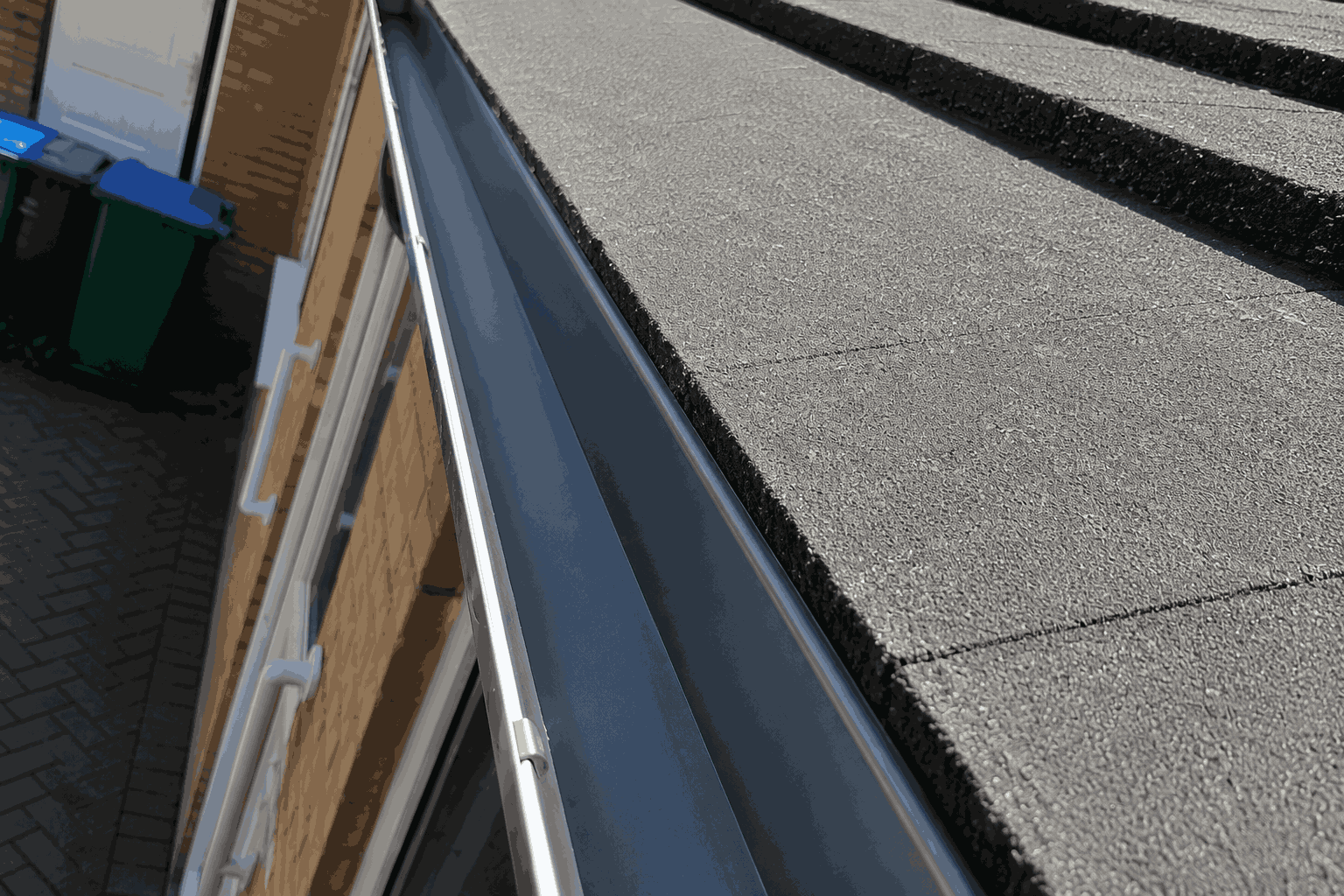
What a Good Answer Actually Sounds Like
There's a real, noticeable difference between a confident answer and a deflecting one:
“Yes, the downpipe's included as standard — we check it every time, not just the gutter run, because a lot of overflow problems are actually the downpipe rather than the gutter itself. We take before-and-after photos of the whole job, so you'll be able to see exactly what was cleared.”
“We can look at the downpipe if it needs it,” or “That's usually fine, we don't normally have issues with that,” without directly confirming it's checked every visit, or without any mention of how the work gets evidenced.
Neither weaker answer is necessarily a scam — but both are a signal that downpipe clearing and photographic proof aren't built into the company's standard process, which means you're relying on them remembering to do it properly on the day, rather than it being the default.
Why This One Question Filters Out Most of the Common Red Flags at Once
Generic advice on avoiding rogue traders — get multiple quotes, check insurance, avoid pressure to decide on the spot — is genuinely sound, and official trading standards guidance consistently makes similar points across the UK. What makes the downpipe-and-photos question particularly effective for gutter cleaning specifically is that it indirectly tests several of those same red flags in one go:
This single question doesn't replace checking insurance or getting a second quote entirely, but it does more diagnostic work per second of conversation than almost anything else you could ask.
Why This Question Matters More in the West Midlands Specifically
This isn't a generic question that happens to apply here too — it's particularly relevant given the mix of property types across the region:
1. Victorian Terraces & Period Properties
Victorian terraces across inner Birmingham, covered in detail elsewhere in this series, often have cast iron downpipes that corrode rather than simply block, meaning a company that doesn't properly check the downpipe can easily miss the actual cause of a recurring problem.
2. Solihull Clay Soil & Foundation Movement Risks
Properties across parts of Solihull sitting on clay-prone ground, where persistent localised water discharge from a neglected downpipe carries genuinely elevated risk compared with more stable ground elsewhere.
3. Rear Extensions & Flat-Roofed Sections
Rear extensions and flat-roofed sections, extremely common across the region's older housing stock, which drain through outlets and scuppers rather than a standard perimeter gutter and are easy for a company without proper process to simply skip.
4. Varied Building Heights & Ladder Limitations
A genuine mix of two, three, and four-storey properties, where a ladder-based provider without proper equipment may quietly avoid a thorough downpipe check simply because it's harder to access safely from the position they're already working in.
A region with this much variation in property type and drainage system genuinely benefits more from a provider whose standard process explicitly includes downpipes and documentation, rather than one working from a generic approach that happens to be fine most of the time.
Common Deflections and What They Actually Mean
Beyond the two example answers above, a few specific phrases come up often enough to be worth recognising on their own:
This sounds reasonable but actually means downpipe clearing is judged on the day, by eye, rather than checked as standard, which is exactly the gap that lets a genuine blockage go unnoticed since a downpipe issue often isn't visible without actually checking it.
A direct admission that downpipes sit outside the standard scope, worth asking immediately what the job actually does cover.
Confidence in the work isn't the same as evidence of the work, and this answer specifically avoids committing to anything checkable afterwards.
Reasonable for a genuinely unusual request, but for a question this fundamental to the job, it suggests downpipe inclusion isn't a fixed, company-wide standard.
Not dishonest in itself, but worth knowing upfront rather than discovering as a surprise add-on once someone's already on the roof.
None of these phrases are necessarily said in bad faith — plenty of tradespeople genuinely haven't thought about how they answer this specific question before. That's exactly the point: the answer reveals whether it's been thought about at all, which correlates strongly with whether the work itself will be thorough.
How to Ask This Without It Feeling Like an Interrogation
The question works just as well asked naturally as it does asked formally. A few ways to fold it into an ordinary booking conversation:
“Just so I know what's included — does that cover the downpipe as well, and do you take before-and-after photos?”
Framed as a scope question rather than a challenge.
“Last time we had someone out, the downpipe wasn't checked and it caused a problem later — is that something you do as standard?”
Framed around a genuine, common concern rather than suspicion of this specific company.
“Before I book, does that include the downpipe, and can I get photos of the work?”
Simply asking directly once a price has been given — most legitimate providers won't find this remotely unusual.
There's no need to apologise for asking or preface it with “sorry to be difficult” — a company worth using won't treat a straightforward scope question as an imposition.
What This Question Doesn't Tell You
Worth being honest about the limits here, since no single question is a complete substitute for proper due diligence. A confident, correct answer to the downpipe-and-photos question doesn't confirm:
- •Punctuality or reliability on the day — that's a separate track record question, better answered by reviews or a personal recommendation than by anything asked at booking.
- •Competitive pricing — a company can answer this question perfectly and still be more expensive than average; it's a quality filter, not a value one.
- •Insurance or formal accreditation, which is worth confirming separately even after a good answer to the main question.
- •How they'll handle something genuinely unexpected, like discovering underground drainage damage during a routine visit — a good answer here suggests competence, but the real test of that only comes up if it actually happens.
This question is best understood as a strong first filter, not a complete vetting process on its own — it just does more work per second of conversation than almost anything else you could ask at the point of booking.
A Pattern Worth Recognising, Not a Specific Story
This is a genuinely common pattern, not a single incident: someone books a gutter clean, the visible gutter looks noticeably better afterwards, and everyone's satisfied — until the next heavy rain, when water is overflowing again in roughly the same spot. The gutter itself was never really the problem; a downpipe blockage further down was causing the overflow the whole time, and it was never checked in the first place. A second call-out follows, sometimes with a different company, and this time the downpipe gets properly checked and cleared — resolving in minutes what the original visit never actually addressed.
This is exactly the scenario the one-question approach is designed to prevent. Asking about downpipe inclusion and photo evidence before booking, rather than discovering the gap only after a second overflow, is the entire point.
A related version of this pattern shows up on taller or commercial properties: a ladder-based visit clears what's reachable from a fixed position, but a downpipe running the full height of a three-storey building, or a section serving a larger commercial roof, gets a quicker check simply because it's harder to access thoroughly from wherever the ladder happens to be positioned. Asking the same question upfront — including how the downpipe itself gets checked, not just the visible gutter — heads off this version just as effectively as the residential one.
Follow-Up Questions Worth Asking Once the First Answer Is Good
If the downpipe-and-photos question gets a confident, specific answer, it's a reasonable signal to move forward — but a couple of quick follow-ups round out the picture without turning the call into an interrogation:
Particularly relevant for anything two storeys or taller, where the answer should reflect genuine consideration of access safety, not just “we'll bring a ladder” without further thought.
A company confident in its process will have a clear, specific answer rather than a vague assurance.
A simple yes should come with no hesitation, since this is basic, expected information for any trade.
None of these need to feel like a cross-examination. A company worth hiring will answer all of them straightforwardly, in the time it takes to book the appointment in the first place.
What to Do If You've Already Booked Without Asking This
If a visit's already booked and this question hasn't come up, it's not too late — simply ask it when the provider arrives, before work starts:
A legitimate provider will have no issue confirming this on the day. If the answer changes noticeably once asked in person compared with how the booking was described, that's worth noting for next time, even if the current visit goes ahead.
Frequently Asked Questions
Related Reading in This Series
Ask us this exact question — we'll tell you straight.
Downpipe clearing and before-and-after photos are included as standard on every visit across Birmingham and the West Midlands, backed by a 1-year guarantee.