
In a house, a blocked gutter is an annoyance. In an office, a school, a surgery or a unit full of stock, it is a serious operational risk to manage.
The consequences are different in kind. Water coming through a ceiling can close a classroom, shut a boardroom or destroy expensive electronic equipment. A blocked outlet on a commercial flat roof can turn a weekend downpour into an interior deluge that nobody notices until Monday morning. A fall from a ladder carrying out an amateur "quick clear" brings a Health and Safety Executive investigation, not just an injury. And a roof or gutter that has never been inspected leaves zero paper trail to prove to an insurer, an auditor or a landlord that the building was adequately maintained.
This guide is for facilities managers, estates teams, school business managers, headteachers, commercial landlords, managing agents, and business owners across Birmingham and the West Midlands. It explains why commercial gutters differ fundamentally from domestic ones, what the law and official guidance say about work at height, how to plan gutter maintenance as a structured programme rather than a series of costly emergencies, what documentation to expect, how access methods compare, and how to choose a qualified contractor.
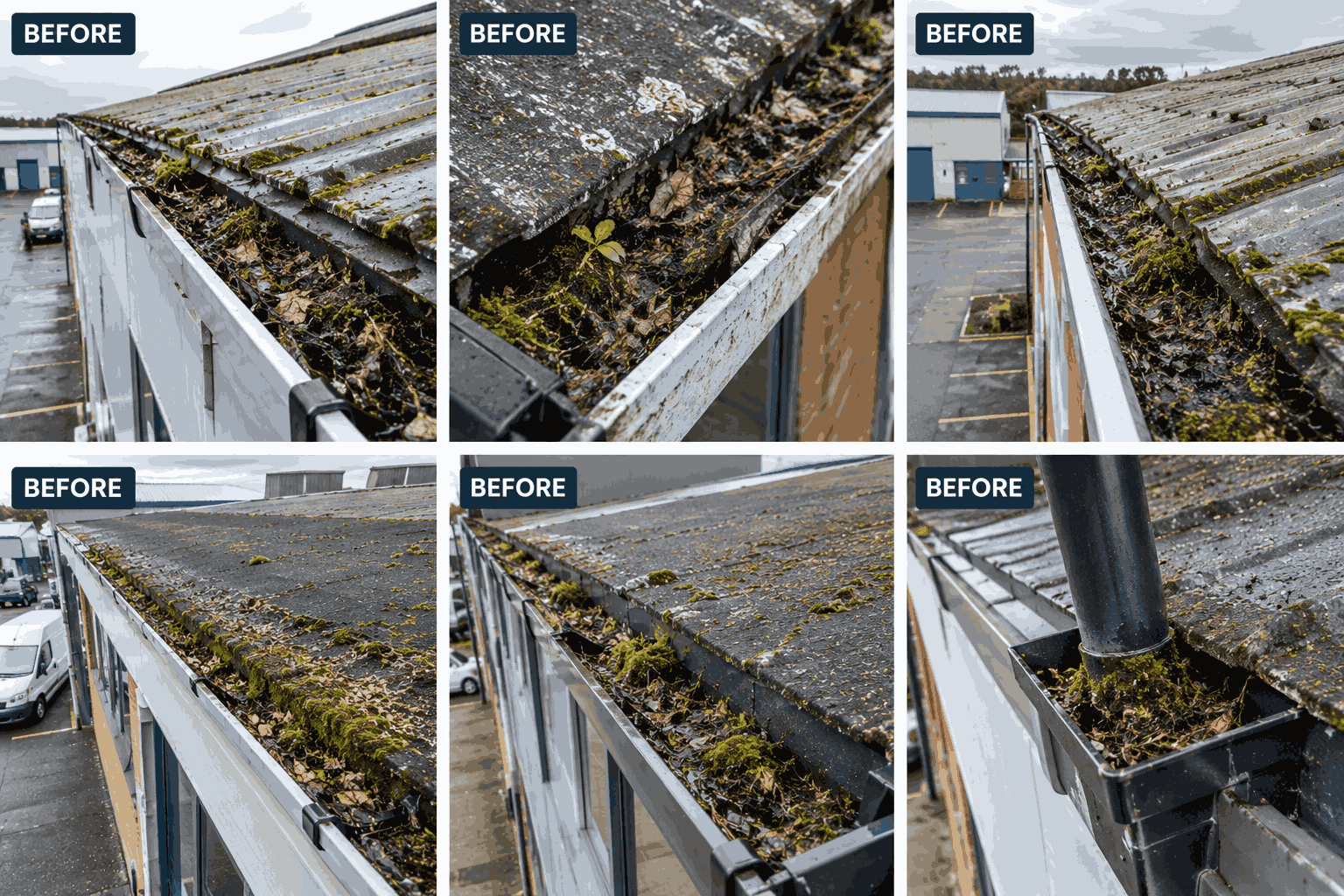
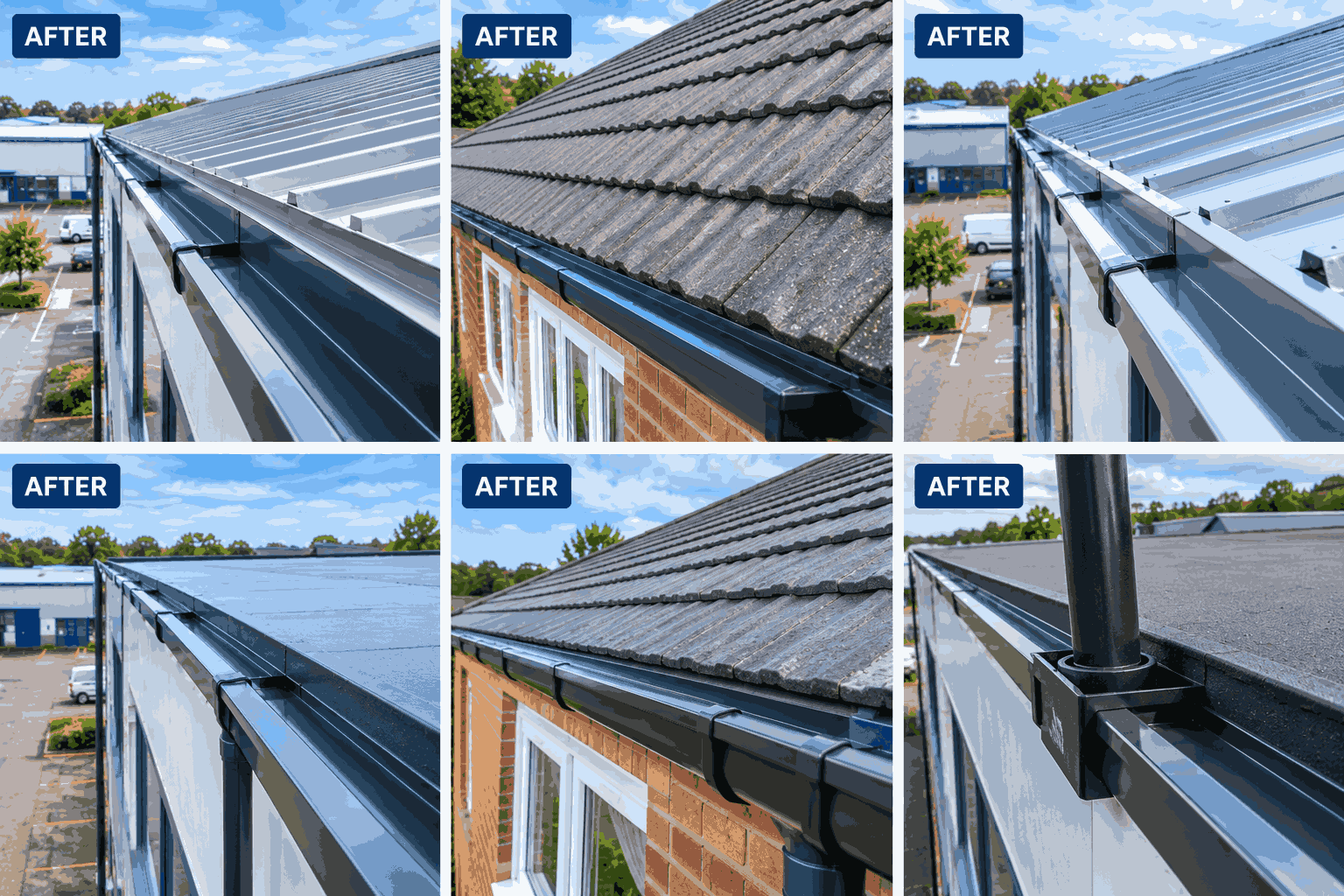
If you manage a premises and need gutters and downpipes cleaned from the ground with no ladders, before and after camera photographs for your records, and transparent invoicing, you can call 0333 8804129 or request a commercial quote online.
How This Guide Fits With Our Other Articles
- Our commercial gutter cleaning service page is where you go to submit site specifications or book a survey.
- Our guide to high-level gutter cleaning in Birmingham covers access methods, scaffolding rules, and insurance questions for tall buildings.
- Our guide to flat roof gutters in Birmingham details box gutters, parapet outlets, and internal drop pipes common on modern commercial units.
- Our guide to gutter cleaning for landlords and letting agents covers residential and HMO portfolios.
- This guide is about the legal duty, the planned programme, the audit trail, and contractor vetting for commercial premises.
Why Commercial Gutters Are Different
A commercial building's roof drainage does the same hydraulic job as a house's, but the scale, risk, and structural complexity change completely:
Massive Surface Scale
Roofs are thousands of square feet. A single blocked 110mm outlet that would cause a minor drip on a semi can trap tons of standing water on a commercial roof.
Concealed Gutter Architectures
Commercial designs feature internal box gutters, valley troughs, and parapet walls. Leaks happen unseen above ceiling tiles rather than outside in the garden.
Severe Business Consequences
Water ingress damages servers, stock, patient files, and expensive flooring. For an academy or medical practice, it can force immediate site closure.
Complex Access Constraints
Heights are greater, roofs often have fragile rooflights, and loading bays, car parks, or public pavements restrict heavy plant machinery.
Multi-Party Lease Responsibilities
Freeholders, commercial tenants under FRI (Full Repairing and Insuring) leases, managing agents, and facilities firms must establish who holds the repairing covenant.
Public & Occupier Safety
Pupils, office workers, delivery drivers, and pedestrians walk below. High-level cleaning requires cordoned exclusion zones and strict RAMS.
The Duty: What Official Guidance Says About Work at Height
Gutter cleaning at height is work at height under UK law. The Health and Safety Executive (HSE) explains that the Work at Height Regulations 2005 (as amended):
"place duties on employers, the self-employed, and any person that controls the work of others" — which explicitly includes facilities managers, headteachers, and building owners who contract third parties.
The HSE sets out an unambiguous, legally enforceable hierarchy for duty holders:
- AVOID work at height wherever reasonably practicable.
- PREVENT falls using existing safe places or equipment where work at height cannot be avoided.
- MINIMISE the distance and consequences of a potential fall where risk cannot be eliminated.
See the official HSE guidance on work at height .
That sequence has an immediate practical implication: the first question must never be "which ladder?" but "can this task be done safely from the ground?" Industrial ground-based vacuum systems solve this for buildings up to 4 storeys. Operators remain firmly on tarmac, completely eliminating fall-from-height liability.
What Schools Are Told About Gutters & Roofs
Schools represent an ideal benchmark for commercial estates. The Grid, the official educational health and safety premises resource, instructs that:
"responsibility for effectively managing and maintaining school buildings lies with the school and sits with the governing body... Ideally, general maintenance of roofs includes clearing leaves, balls, silt etc. from the gutters and drainage channels at least four times a year or more often depending on weather and nearby trees."
It adds that after heavy storms the roof must be checked for ponding, dated records of each maintenance visit must be retained for warranty and insurance purposes, and "blocked gutters and drainage should be ruled out before a suspected defect is reported to roofing consultants". On working at height, it explicitly mandates that "there must be no lone working when working at height". See The Grid school buildings maintenance guidance .
Furthermore, the National Audit Office (NAO) report on the condition of school buildings highlighted that funding is too often squandered on emergency reactions rather than planned maintenance. See the NAO report on the condition of school buildings .
The Cost of Reacting Instead of Planning
| Reactive Approach (Failure-Driven) | Planned Approach (Scheduled Contract) |
|---|---|
| Water pours into classroom or boardroom; emergency call-out | Scheduled clean on an agreed calendar slot |
| Urgent out-of-hours callout at premium emergency rates | Fixed contractual pricing agreed in advance |
| Damage discovered after equipment, carpets, and records are soaked | Minor defects spotted early via HD camera inspection |
| No maintenance audit trail; disputes with loss adjusters or landlords | Dated photographic logs and invoices filed for compliance |
| Classes evacuated, meetings cancelled, staff distracted | Work timed quietly around lesson breaks or office schedules |
| Contractor chosen in panic with unknown health and safety vetting | Vetted contractor with £5M PLI, RAMS, and proper equipment |
Commercial Building Types and Their Needs
Offices & Commercial HQs
Mix of multi-storey flat roofs, parapets, and internal rainwater drops. Ingress threatens server rooms, electrical risers, and trading floors.
Schools, Academies & Colleges
Varied estates with Victorian wings, 1970s flat blocks, and sports halls. Tennis balls, shuttlecocks, and autumn leaf canopies choke outlets.
Surgeries, Clinics & Care Facilities
Zero tolerance for mould or moisture. Demands quiet, unobtrusive ground equipment, sterile hygiene awareness, and immaculate site conduct.
Warehouses & Logistics Units
Expansive metal-profile roofs with 100-metre valley gutters. Overflowing gutters spill directly into high-bay pallet racking and electronics stock.
Visual Verification: Commercial Clearance in Action
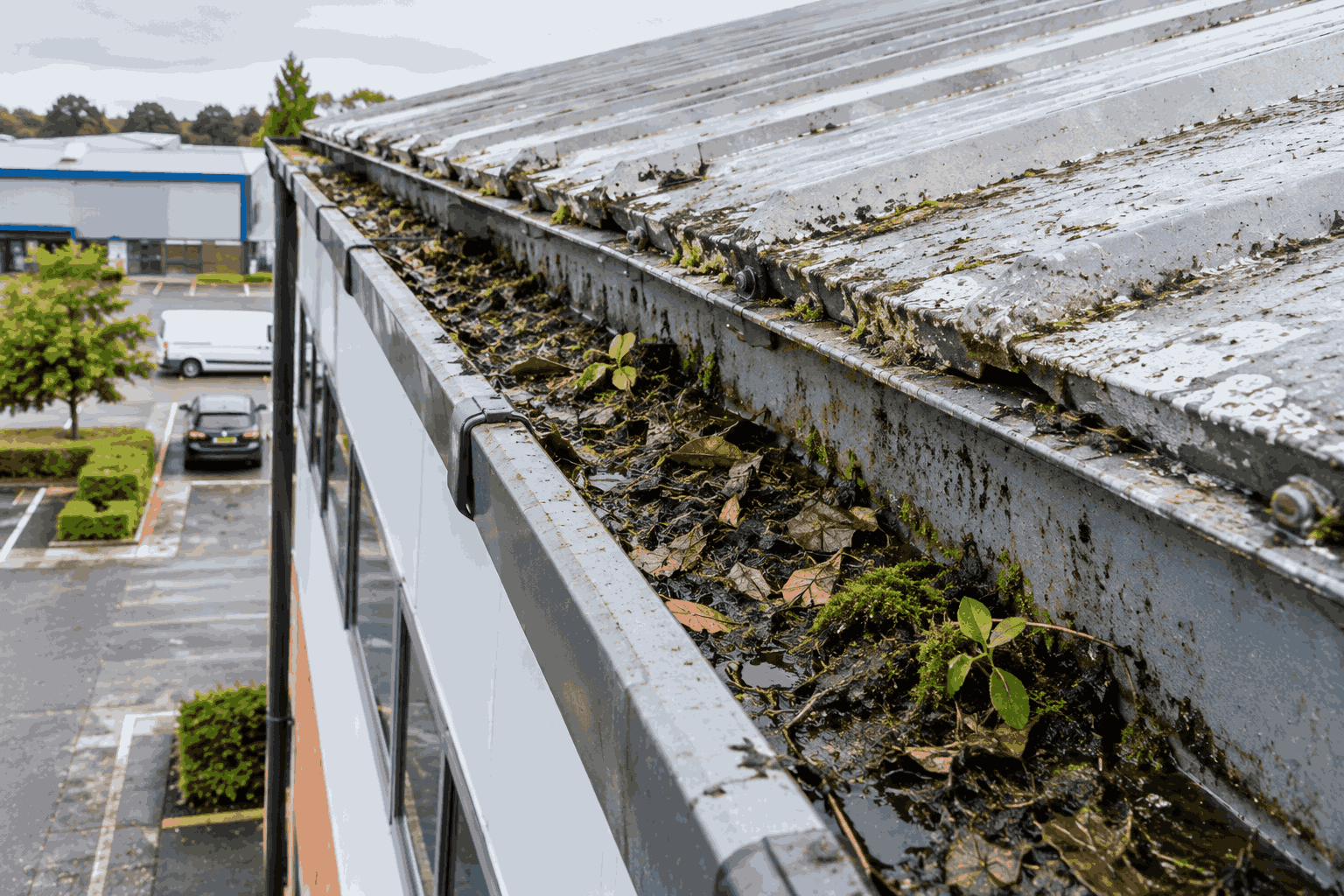 Before: Choked Commercial Trough
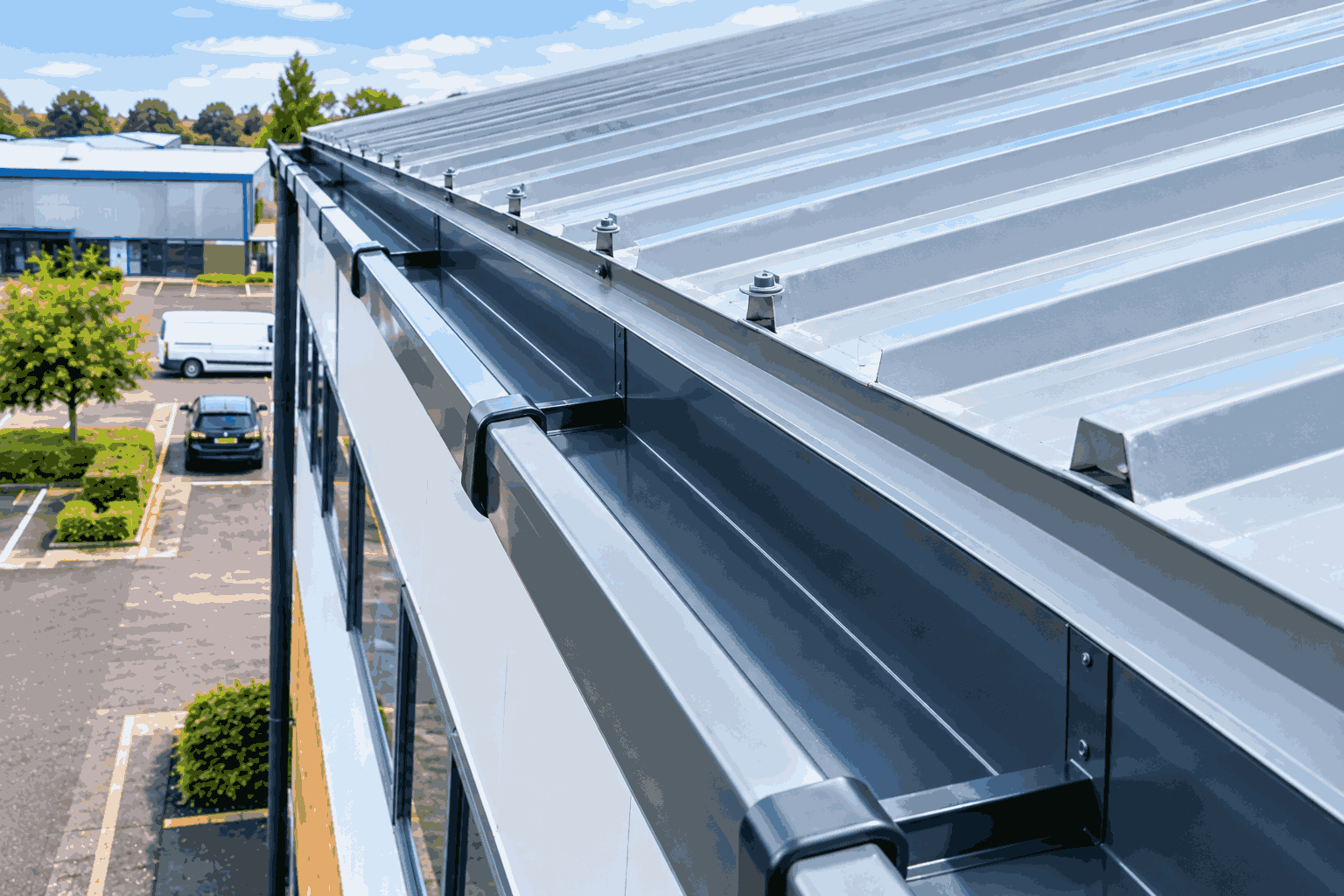 After: Bare Channel & Flow Tested
Commercial Roof and Gutter Architectures
Briefing a contractor requires understanding your specific rainwater goods:
- External Box & Half-Round Gutters: Located along outer eaves. Reachable up to 4 storeys with ground vacuum carbon-fibre poles.
- Parapet & Valley Gutters: Built behind perimeter walls or between roof spans. Collect enormous volumes and require wide-bore clearance.
- Internal Rainwater Downpipes: Vertical pipes dropping through offices, retail units, or ceiling voids. Blockages cause internal wall stains.
- Flat Roof Outlets with Domes: Sump drains on felt, asphalt, or single-ply roofs. Wire leaf cages catch balls, litter, and leaves, quickly ponding water.
- Lead & Membrane Lined Gutters: Common in historic civic buildings. Bradford Council's guidance notes that lead gutter linings must be checked regularly for seam splits. See Bradford Council rainwater goods guidance .
- Fragile Surfaces & Rooflights: HSE rules dictate that no operative may set foot near fragile rooflights without collective edge barriers or crawl boards.
Access Methods Compared: Cost & Risk Hierarchy
| Access Method | Operational Mechanism | Key Advantages | Limitations & HSE Considerations |
|---|---|---|---|
| Ground Vacuum & Telescopic Pole | Industrial 3000W suction via carbon pole with live wireless camera | Zero work at height; rapid deployment; no lawn or pavement damage | Maximum vertical reach is 4 storeys (approx. 15m); deep internal box gutters require roof walk systems |
| MEWP (Cherry Picker) | Hydraulic powered mobile boom platform | High reach for tall facades; stable basket | Needs firm level ground; expensive hire; permits required if positioned on public highways |
| Scaffold Tower | Erected static alloy tower at eaves | Safe platform for heavy structural gutter replacement | Labour-intensive erection; security risk on school grounds overnight; substantial setup cost |
| Ladders | Standard leaning extension ladder | Low upfront cost | HSE strictly limits ladders to short, light work (under 30 mins) with 3 points of contact; lone working at height is illegal on managed sites |
| Roof Walk & Manned Fall Arrest | Operatives harnessed to certified mansafe wire systems | Direct physical access to large central valley gutters | Requires certified anchor points, rescue plans, and trained harness operatives |
Building a Planned Commercial Gutter Programme
A Gutter Cleaning Tender Specification You Can Copy
SCOPE & COMPLIANCE CLAUSES:
1. Scope of Work: Thorough clearance of all external eaves gutters, hopper heads, and downpipe outlets. Removal of all organic silt, moss, leaves, and foreign objects. Flow verification post-clearance.
2. Safety & Access: The contractor shall strictly avoid work at height wherever practicable, utilizing ground-based telescopic vacuum technology. Where working at height is unavoidable, task-specific RAMS must be supplied 5 days prior. Zero lone working at height permitted.
3. Site Protocol: Compliance with school safeguarding procedures, DBS registration where required, agreed exclusion cordons, and scheduled working outside core movement times.
4. Waste & Housekeeping: 100% of organic waste bagged and removed from site. No debris deposited on paths, car parks, or shrubbery.
5. Documentation: Comprehensive report including dated before-and-after camera photographs for every elevation, defect schedule, and VAT invoice referencing Official Purchase Order.
6. Insurance: Minimum £5,000,000 Public Liability Insurance certificate submitted prior to site induction.
Reading a Commercial Quote: Essential Line Items
| Contract Line | What It Should State | Why It Protects Your Organisation |
|---|---|---|
| Site Schedule | Detailed list of blocks, wings, and outbuildings | Eliminates disputes regarding forgotten elevations |
| Access Method | Ground-based suction specified per elevation | Documents adherence to HSE work at height hierarchy |
| Downpipe Outlets | Cleared & flow tested down to ground gullies | Prevents newly cleared gutters backing up at neck |
| Safety Documentation | Task-specific RAMS and COSHH if applicable | Protects facilities managers under statutory regulations |
| Waste Removal | Debris removal included in price | Guarantees playgrounds and walkways remain immaculate |
| Photographic Evidence | High-definition before and after photos supplied | Essential proof for governors, trustees, and insurance claims |
| Public Liability | Minimum £5,000,000 policy verified | Shields property against catastrophic accidental damage |
Who Is Responsible? Leases, Contracts and Insurance
Commercial gutter responsibility varies by lease structure:
- Full Repairing & Insuring (FRI) Leases: The commercial tenant is legally responsible for external roofline, drainage, and gutter maintenance.
- Internal Repairing Only Leases: The landlord retains structural responsibility, recovering costs via a service charge.
- Multi-Tenanted Business Parks: Managing agents oversee collective roof clearing schedules across shared service blocks.
- Academy Trusts & Schools: Governing bodies hold statutory responsibility for asset preservation and pupil safety.
Insurance Gradual Deterioration Exclusions: Commercial insurers operate strict exclusions for gradual maintenance neglect. Insurers such as Ageas exclude damage caused by lack of periodic maintenance. Dated camera inspection records prove proactive asset management.
4-Week Handover Guide for New Facilities Managers
Week 1 (Audit Records): Review previous maintenance invoices, roof warranties, and past leak logs. Gaps in records mean gutters should be treated as unmaintained.
Week 2 (Site Perimeter Walk): Walk every elevation during rainfall. Note overflowing gutters, green algae stains on brickwork, and downpipes discharging improperly.
Week 3 (Staff Consultation): Speak to site caretakers and department heads about rooms that chronically smell damp or suffer ceiling drips.
Week 4 (Schedule Contract): Formalize a scheduled ground-based suction contract with agreed frequencies, risk assessments, and PO payment terms.
Commercial Premises Across Birmingham & West Midlands
Birmingham Central, Digbeth & Colmore Row
High-density multi-storey commercial offices, educational campuses, and converted Victorian warehouses requiring pedestrian management.
Solihull Business Parks
Modern campus developments and grammar schools surrounded by extensive deciduous woodland and high autumn debris.
Sutton Coldfield
Independent academies, medical centres, and retail parades on leafy suburban approaches.
Wolverhampton & Walsall
Industrial estates, logistics hubs, and council premises. Walsall Council guidance highlights severe winter freeze risks in blocked industrial goods.
What We Will and Won't Promise
What We Will Deliver
- • Safe ground-based vacuum clearing up to four storeys without ladder liability.
- • Dated before and after high-definition camera verification for every elevation.
- • Task-specific RAMS and strict adherence to school safeguarding and site sign-in rules.
- • 100% waste collection, removal, and lawful disposal off-site.
- • Transparent commercial invoicing referencing your Purchase Order numbers.
- • £5,000,000 Public Liability Insurance cover.
What We Won't Do
- • We will never permit lone working at height on your site.
- • We won't claim to reach inaccessible internal valley gutters without proper specialist access.
- • We won't disrupt lessons, patient care, or office operations.
- • We do not sub-contract to unvetted, uninsured casual labour.
Key Takeaways for Commercial Duty Holders
- Statutory duty of care: Facilities managers and headteachers who contract maintenance carry legal duties under HSE Work at Height Regulations 2005.
- Prioritise ground-based suction: The law requires avoiding height where possible. SkyVac suction clears up to 4 storeys without putting operatives on ladders.
- Rule out gutters before roofing quotes: 80% of interior ceiling leaks in schools and offices are caused by clogged gutter outlets, not roof membrane failure.
- Insist on photographic audit trails: Governors, trustees, and insurance loss adjusters require dated photographic proof of scheduled maintenance.